 |
| Frost on the remains of spent plants |

Friday, 27 July 2018
Frost in the vegetable garden
We have had some heavy frosts this winter. I keep meaning to sneak out and take pictures. Unfortunately I only remembered to take pictures on mornings when it wasn't overly cold. The frost is still very pretty though.

Sunday, 22 July 2018
How to prevent thornless berries reverting to thorny
Thornlessness in brambleberries appears to be influenced by at least three different factors. Scientists and plant breeders have understood these factors reasonably well for quite some time. Each of them has different advantages and disadvantages. But how do you keep a thornless berry thornless, and how do you prevent a brambleberry from reverting to being thorny?
First, let me tell you about my experience growing a "thornless youngberry", then let me explain the three different ways that brambleberries can be thornless, then I will explain what you do about each of the three types.
First, let me tell you about my experience growing a "thornless youngberry", then let me explain the three different ways that brambleberries can be thornless, then I will explain what you do about each of the three types.
 |
| Thornless youngberry starting to ripen |
Thursday, 19 July 2018
Kombucha Continuous Brew
We have been keeping various ancient cultures for years. We started with milk kefir, then went on to things such as water kefir and sour dough. Some cultures we have kept going for years, others we have lost, and others we decided to stop doing for now due to various reasons. One of the cultures we have at the moment that I really enjoy is kombucha.
Unfortunately the origin of kombucha has been lost to history. Several romantic theories have been made about the origins of kombucha, none appear to be based on anything other than dramatic story telling, and these stories eventually merged to the one that is often told today. The truth is that we know roughly where kombucha originated, we know vaguely when it started to become popular, but it doesn’t make one ounce of difference. The drink tastes good, it is simple to make, and it reportedly has several health benefits. Who really cares when or how it was discovered.
I thought I would write a blog post to share the down sides of continuous brew kombucha, and test some of the health claims. I think you may be surprised by the results.
There are many anecdotal reports about the health benefits of kombucha, these range from things that seem reasonable to utterly absurd exaggerations that only a fool would be taken in by and everything in between. Some health benefits have been scientifically tested, while others have not. Some of the more commonly reported health benefits include decreased blood pressure, evening out of blood sugars, improved digestion, weight loss, increase in general immunity, lowered levels of anxiety and depression, and improvement in overall health.
Some of the alleged health benefits would be lovely, while others would actually be bad for me. Decreasing blood pressure would be dreadful for me as I already have low blood pressure. It is possible that kombucha helps even out blood pressure, but the people who rave about it mostly have high blood pressure? Or maybe it has no noticeable effect on blood pressure and this is one of the many false claims? I don’t know, so I decided to just drink it and see how I went.
Nothing works immediately, if anything is actually going to actually make you healthier it is going to take time before you can notice the difference. When you notice the difference straight away it is often not going to do you a great deal of good long term (such as in the case of pain killers or antibiotics) or it is a placebo. For the past few months I have been drinking kombucha most days.
So how do I feel after drinking kombucha for around six months, and how does that compare to before I started to drink kombucha?
Unfortunately I have to admit that I feel exactly the same as I did before I stared to drink kombucha. That's disappointing and unexpected.
My digestion is no better or worse, my general immunity is no different than before, my blood pressure and blood sugars are the same as always, and my overall level of health has not been altered one bit. I was not expecting that.
I would love for kombucha to be a cure all tonic that made me as fit and strong as I was ten years ago, but it is not. This doesn’t matter, I plan to keep brewing and drinking kombucha simply because I like it.
I don’t know if kombucha ever improves people’s health, maybe it helps some people but not others. Perhaps my health made no improvement as I was relatively healthy to begin with. I have issues with my neck and back due to an injury, I have low blood pressure and I need to keep an eye on my blood sugars (I have almost cured myself of blood sugar issues), but I eat well and am not sick all that often. I don’t eat a lot of processed food and I sometimes drink water kefir so my gut flora is probably well established and robust.
Maybe kombucha improves the overall health of people who are generally unhealthy, eat poorly, and have imbalances in their gut flora. I will continue to brew and drink kombucha simply because I like the taste, any health benefits that I may be getting from it are just a bonus.
I should put up a post with the recipe for how I make kombucha, partly to help others but partly in case I ever forget. The recipe I use is really simple and takes very little time. When I do write a post with the recipe I will try to remember to link to it from here.
I don’t currently sell kombucha starter scoby through my for sale page as I am concerned about how it is covered under food safety laws. I know that it is virtually impossible to legally sell eggs at markets in Australia due to food safety laws, I assume kombucha is probably restricted in similar ways.
Unfortunately the origin of kombucha has been lost to history. Several romantic theories have been made about the origins of kombucha, none appear to be based on anything other than dramatic story telling, and these stories eventually merged to the one that is often told today. The truth is that we know roughly where kombucha originated, we know vaguely when it started to become popular, but it doesn’t make one ounce of difference. The drink tastes good, it is simple to make, and it reportedly has several health benefits. Who really cares when or how it was discovered.
I thought I would write a blog post to share the down sides of continuous brew kombucha, and test some of the health claims. I think you may be surprised by the results.
 |
| Continuous brew kombucha |
Early this year a very generous person gave me their beautiful continuous brew kombucha set up. This thing is amazing. It is large enough to make decent amounts of kombucha, and other than drawing off liquid and filling it up when low the system pretty much takes care of itself. I have no idea if continuous brew is as good as batch brewing, but it works well for us so I am happy with it. There have been two down sides to continuous brewing kombucha so far.
Firstly, and unimportantly, my scoby is not as pretty as the ones I see on the internet. On the internet they always look like a perfect neat pile of fluffy pancakes floating blissfully in clear tea. My scoby looks more like a pile of pancakes that was quickly eaten and immediately puked up by a donkey. I am sure I could remove the messier ones and make it look prettier for a short time if I wanted to, but it would soon get back to looking like this. It does its job well, so it doesn’t matter what it looks like.
Secondly, the only important down side I have noticed is that the little tap gets clogged from time to time. The tap had a little mesh filter behind it, I removed that filter and it has never clogged since.
Firstly, and unimportantly, my scoby is not as pretty as the ones I see on the internet. On the internet they always look like a perfect neat pile of fluffy pancakes floating blissfully in clear tea. My scoby looks more like a pile of pancakes that was quickly eaten and immediately puked up by a donkey. I am sure I could remove the messier ones and make it look prettier for a short time if I wanted to, but it would soon get back to looking like this. It does its job well, so it doesn’t matter what it looks like.
Secondly, the only important down side I have noticed is that the little tap gets clogged from time to time. The tap had a little mesh filter behind it, I removed that filter and it has never clogged since.
 |
| Kombucha scoby, mine doesn't look as pretty as the ones I see on the internet! |
There are many anecdotal reports about the health benefits of kombucha, these range from things that seem reasonable to utterly absurd exaggerations that only a fool would be taken in by and everything in between. Some health benefits have been scientifically tested, while others have not. Some of the more commonly reported health benefits include decreased blood pressure, evening out of blood sugars, improved digestion, weight loss, increase in general immunity, lowered levels of anxiety and depression, and improvement in overall health.
Some of the alleged health benefits would be lovely, while others would actually be bad for me. Decreasing blood pressure would be dreadful for me as I already have low blood pressure. It is possible that kombucha helps even out blood pressure, but the people who rave about it mostly have high blood pressure? Or maybe it has no noticeable effect on blood pressure and this is one of the many false claims? I don’t know, so I decided to just drink it and see how I went.
Nothing works immediately, if anything is actually going to actually make you healthier it is going to take time before you can notice the difference. When you notice the difference straight away it is often not going to do you a great deal of good long term (such as in the case of pain killers or antibiotics) or it is a placebo. For the past few months I have been drinking kombucha most days.
So how do I feel after drinking kombucha for around six months, and how does that compare to before I started to drink kombucha?
 |
| Kombucha - the lines let me know when to refill |
Unfortunately I have to admit that I feel exactly the same as I did before I stared to drink kombucha. That's disappointing and unexpected.
My digestion is no better or worse, my general immunity is no different than before, my blood pressure and blood sugars are the same as always, and my overall level of health has not been altered one bit. I was not expecting that.
I would love for kombucha to be a cure all tonic that made me as fit and strong as I was ten years ago, but it is not. This doesn’t matter, I plan to keep brewing and drinking kombucha simply because I like it.
I don’t know if kombucha ever improves people’s health, maybe it helps some people but not others. Perhaps my health made no improvement as I was relatively healthy to begin with. I have issues with my neck and back due to an injury, I have low blood pressure and I need to keep an eye on my blood sugars (I have almost cured myself of blood sugar issues), but I eat well and am not sick all that often. I don’t eat a lot of processed food and I sometimes drink water kefir so my gut flora is probably well established and robust.
Maybe kombucha improves the overall health of people who are generally unhealthy, eat poorly, and have imbalances in their gut flora. I will continue to brew and drink kombucha simply because I like the taste, any health benefits that I may be getting from it are just a bonus.
 |
| Kombucha taste good to me |
I should put up a post with the recipe for how I make kombucha, partly to help others but partly in case I ever forget. The recipe I use is really simple and takes very little time. When I do write a post with the recipe I will try to remember to link to it from here.
I don’t currently sell kombucha starter scoby through my for sale page as I am concerned about how it is covered under food safety laws. I know that it is virtually impossible to legally sell eggs at markets in Australia due to food safety laws, I assume kombucha is probably restricted in similar ways.
Saturday, 14 July 2018
How to Store Water Chestnuts Over Winter (The Easy Method That Actually Works)
Chinese water chestnuts (Eleocharis dulcis) are very simple to grow at home and can be very productive. For some reason people used to tell me how difficult they were to grow, but the hardest part was finding any for sale in Australia that were not in a can!
To grow water chestnuts you don’t need acreage, you don’t need a stream or a pond, and you certainly don’t need to live in the tropics. Chinese water chestnuts can easily be grown in most of Australia if you have access to soil, water, and sunlight. I grow them and I sell them so you can also grow them. I grow water chestnuts in a cheap bucket.
Being perennial vegetables, you can plant once and harvest forever. In order to do this you need to store some water chestnut corms over winter while they are not actively growing. Let me explain how I over winter water chestnut corms.
I have been told that there is an art to storing water chestnuts over winter in order to grow them the following spring and that it is very complex. I wish someone told me about this earlier as I have been growing them for years and never had any issues storing them with no effort!
Perhaps this advice stems from overseas growers whose climate is vastly different to Australia. You can store them in slightly damp sphagnum moss in the crisper of the fridge and inspect them weekly as per the advice, but you don’t have to. I have certainly never done that, it sounds like too much work and too much space.
I store them in the same bucket of soil that they grew in over summer. I grow water chestnuts in buckets of soil, over winter they die down so I harvest some and leave some behind. I don’t water the bucket or really think about it, and that is all I do until spring when they start to grow again.
I explained in a previous post how I grow water chestnuts in a bucket. There are a few things other not mentioned in that post that you probably need to think about if you have just got water chestnuts for the first time and are waiting over winter before you can grow them. Most of it is common sense, and they are very hardy.
To grow water chestnuts you don’t need acreage, you don’t need a stream or a pond, and you certainly don’t need to live in the tropics. Chinese water chestnuts can easily be grown in most of Australia if you have access to soil, water, and sunlight. I grow them and I sell them so you can also grow them. I grow water chestnuts in a cheap bucket.
Quick answer: I simply leave my dormant water chestnuts in the same bucket of soil where they grew during summer. I stop watering them, let winter rain provide enough moisture, and they sprout again in spring with very little effort.
 |
| Organic home grown water chestnuts |
Being perennial vegetables, you can plant once and harvest forever. In order to do this you need to store some water chestnut corms over winter while they are not actively growing. Let me explain how I over winter water chestnut corms.
I have been told that there is an art to storing water chestnuts over winter in order to grow them the following spring and that it is very complex. I wish someone told me about this earlier as I have been growing them for years and never had any issues storing them with no effort!
Perhaps this advice stems from overseas growers whose climate is vastly different to Australia. You can store them in slightly damp sphagnum moss in the crisper of the fridge and inspect them weekly as per the advice, but you don’t have to. I have certainly never done that, it sounds like too much work and too much space.
I store them in the same bucket of soil that they grew in over summer. I grow water chestnuts in buckets of soil, over winter they die down so I harvest some and leave some behind. I don’t water the bucket or really think about it, and that is all I do until spring when they start to grow again.
 |
| Chinese Water Chestnut Dormant Corms |
Water chestnuts will die if they dry out
This seems pretty obvious. If you put water chestnut corms on the kitchen windowsill or in your sock drawer over winter they will dry out and be dead by spring. They are pretty hardy and it takes them quite a lot of time to dry out and die, so you don’t need to stress. Putting them on the bench for a week or so while you work out what to do with them shouldn’t harm them. Many people store them in a pot of soil that is as wet as any pot plant you may have (ie not very wet at all). They don’t need to be overly damp when dormant, being too damp will rot them, but they also don’t like to be completely dry for too long.Water chestnut corms will not survive being frozen
Around Canberra the top of the bucket and the sides may freeze a little, but the center will not. The soil acts as an insulator and few places in Australia get cold enough to kill them in the soil. Any corms that are in the center or deeper in the bucket will not freeze, and they will survive to grow in spring. Once they sprout in spring frost is not great for them, but I have never lost a water chestnut plant to the frost. |
| Water Chestnuts |
Water chestnuts will rot if they are too wet while they are dormant
Water chestnuts grow in soil that is submerged over summer. They cope really well being wet and thrive in places where most weeds quickly perish. When they are dormant they will rot if too wet for too long. I don’t water them over winter, I let the rain take care of that for me. If we have had lots of rain I will tip off excess water to be able to harvest them and from there on the rain will look after them. Planting them in a pot of soil and keeping this in a saucer of water is fine, but it is best not to keep them under water while they are dormant. Please don’t store them in a glass of water or in your fish tank over winter.Heat and sunlight
Sunlight won’t hurt them or render them inedible as it does in things such as potatoes. If the corms are out of soil and get a lot of direct sunlight for a long time they may eventually dry out and die. If they are in damp soil and get too warm for too long they may start to grow. Around Canberra the soil stays cool over winter, so this isn’t too much of an issue here. I know some people who move their buckets into the garage over winter to protect from extremes of temperature and stop them getting overly wet, but you don’t have to. |
| Water chestnut corms |
Water chestnuts are very hardy
Keeping all of the above in mind, I have left corms outside on the pavers for a few weeks over winter after I dug them up, got distracted by something, and forgot about them. They were dry, they had direct sunlight, they had wide temperature fluctuations and experienced light frosts each night. These corms all grew the same as the ones I actually took care of. So they really are pretty hardy.I've stored my water chestnuts this way for many years without losing a crop.
Where to buy Chinese water chestnuts for growing in Australia
Very few places in Australia sell water chestnut corms or plants for some reason, I sell them through my for sale page. I also sell a range of other organically grown perennial vegetables, heirloom vegetable seeds, herbs, berries, and ornamental plants.Wednesday, 11 July 2018
Growing potatoes from True Potato Seed
Usually in Australia potatoes are grown from clones. Sometimes these are pieces of existing potatoes or small potatoes. Confusingly people sell 'seed potatoes' which are just small potatoes that are used for planting. Every plant that is grown from 'seed potatoes' are genetically identical clones.
True Potato Seed is different, they are actual botanical seeds. These are made in the same way that any plant makes seeds. Every plant that arises from true potato seed is genetically different. If you plant a dozen true potato seeds you will get a dozen different varieties of potato. If you find one you like you can grow them vegetatively from there. This is how plant breeders have come up with the different varieties of potatoes you can buy.
This year I got some True Potato Seed and grew some potatoes from those true botanical seeds. Each and every plant that grows from true potato seed is genetically unique.
This year the ones I grew were diploid potatoes, which are different from the usual tetraploid potatoes. They are more of a wild variety of potato and have not had polyploidy induced in them. They also had a huge amount of genetic diversity which I love. The seed grown potato plants looked nice and on some plants the flowers were stunningly beautiful.
True Potato Seed is different, they are actual botanical seeds. These are made in the same way that any plant makes seeds. Every plant that arises from true potato seed is genetically different. If you plant a dozen true potato seeds you will get a dozen different varieties of potato. If you find one you like you can grow them vegetatively from there. This is how plant breeders have come up with the different varieties of potatoes you can buy.
This year I got some True Potato Seed and grew some potatoes from those true botanical seeds. Each and every plant that grows from true potato seed is genetically unique.
This year the ones I grew were diploid potatoes, which are different from the usual tetraploid potatoes. They are more of a wild variety of potato and have not had polyploidy induced in them. They also had a huge amount of genetic diversity which I love. The seed grown potato plants looked nice and on some plants the flowers were stunningly beautiful.
 |
| Yield from one true potato seed grown plant, not huge the first year |
Saturday, 7 July 2018
Variegated maidenhair fern Adiantum raddianum 'Variegata' in Australia
I don't grow many ornamental plants but I love maidenhair ferns, I think that they are beautiful. I have some on my desk at work to help my day be less dreary.
Years ago I heard of variegated maidenhair ferns, they sounded really nice. I looked for them and no one seems to sell them. For some reason there are very few pictures of variegated maidenhair ferns anywhere on the internet. Considering how few images I found, I started to wonder if they actually existed, or if they were just photoshopped images.
I searched for a variegated maidenhair fern (Adiantum raddianum 'Variegata') for years. For some reason very few people own variegated maidenhair ferns in Australia. I found a few people who used to have one, and some places that used to sell them but no longer do, but getting one myself proved difficult. I spoke to a few fern collectors, all of which had fond memories of once seeing this plant, but none who currently had one. All of this convinced me that they did exist. Then I eventually tracked one down, and I bought it.
Years ago I heard of variegated maidenhair ferns, they sounded really nice. I looked for them and no one seems to sell them. For some reason there are very few pictures of variegated maidenhair ferns anywhere on the internet. Considering how few images I found, I started to wonder if they actually existed, or if they were just photoshopped images.
I searched for a variegated maidenhair fern (Adiantum raddianum 'Variegata') for years. For some reason very few people own variegated maidenhair ferns in Australia. I found a few people who used to have one, and some places that used to sell them but no longer do, but getting one myself proved difficult. I spoke to a few fern collectors, all of which had fond memories of once seeing this plant, but none who currently had one. All of this convinced me that they did exist. Then I eventually tracked one down, and I bought it.
 |
| Variegated maidenhair fern Adiantum raddianum 'Variegata' |
My variegated maidenhair fern was tiny when I got it. The little fern is growing nicely and I hope to be able to divide it and when it is larger I would love to grow some spores from it. I will be curious to see if spore grown plants are all variegated, or if only a percentage are variegated, or if none of them will display variegation. I have asked a few fern collectors and none of them seem to know.
I looked on the internet and there are only about half a dozen pictures of these elusive and enigmatic plants. This makes it difficult to decide if you really want to get one. If these things are so great why have so few people posted pictures of them on the internet? The lack of pictures made it difficult to know if they really exist. I am happy to say that variegated maidenhair ferns do exist, and they are very pretty. I think the lack of pictures is due to their rarity. I don't know why they are rare.
As you can see my fern displays diversity in its variegation. Some fronds have more white than others. Even on one frond it shows a lot of variation, some pinnules are entirely white, others are entirely green, and most will be green with splashes and stripes of green.
As so few people have ever seen these delightful ferns I took some pictures of my variegated maidenhair fern Adiantum raddianum 'Variegata' to show the world how pretty variegated maidenhair ferns are.

At this stage I only have the one small variegated maidenhair fern. I really like it. I can hardly wait for my plant to grow larger. I hope in spring to be able to divide my fern so I have more of them, even if I can split it into two I would be happy.
I looked on the internet and there are only about half a dozen pictures of these elusive and enigmatic plants. This makes it difficult to decide if you really want to get one. If these things are so great why have so few people posted pictures of them on the internet? The lack of pictures made it difficult to know if they really exist. I am happy to say that variegated maidenhair ferns do exist, and they are very pretty. I think the lack of pictures is due to their rarity. I don't know why they are rare.
As you can see my fern displays diversity in its variegation. Some fronds have more white than others. Even on one frond it shows a lot of variation, some pinnules are entirely white, others are entirely green, and most will be green with splashes and stripes of green.
As so few people have ever seen these delightful ferns I took some pictures of my variegated maidenhair fern Adiantum raddianum 'Variegata' to show the world how pretty variegated maidenhair ferns are.
 | |
|
 | |
|
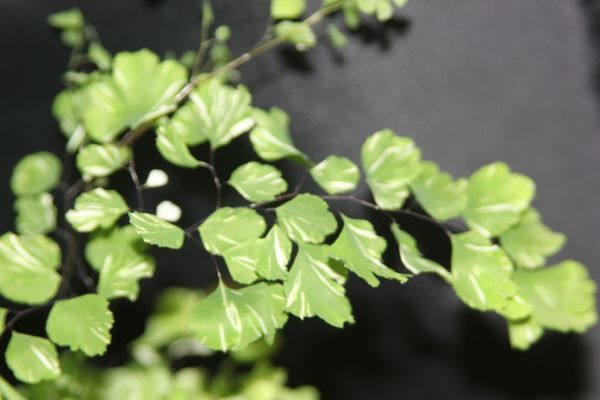 |
| Variegated maidenhair fern frond - some pinnules are entirely white |

 |
| Variegated maidenhair fern pinnules range from entirely white to almost entirely green. |
 |
| Variegated maidenhair fern needs repotting |
 |
| Variegated maidenhair fern in a larger pot |
At this stage I only have the one small variegated maidenhair fern. I really like it. I can hardly wait for my plant to grow larger. I hope in spring to be able to divide my fern so I have more of them, even if I can split it into two I would be happy.
Update 2026: this fern is still alive and growing well. Over the years I have divided it somewhat, sold a few, and given some away. I also wrote a comparison post of various maidenhair fern varieties I grow.
Maidenhair ferns are surprisingly simple to grow if you understand their basic needs. I wrote a blog post describing how I grow maidenhair ferns which has worked well for me over the long term.
Ocassionally I sell variegated maidenhair ferns through my for sale page, I never have large numbers of these, and they usually sell out fast when I list them.
Ocassionally I sell variegated maidenhair ferns through my for sale page, I never have large numbers of these, and they usually sell out fast when I list them.
Sunday, 1 July 2018
Strawberry x Raspberry hybrid plant photos
I have been messing around with plant breeding for as long as I can remember. Some simple things, others more complicated. I mentioned in an earlier post that I have recently crossed a strawberry with a raspberry. I am very excited about this.
I wasn't planning on putting up any pictures until Spring once I know what will survive winter and the plants will be a lot larger and more worth looking at. But I have had some people email and ask for photos, so I made this post to put up the first few pictures.
They aren't great pictures, and the surviving plants have grown a fair bit since the pictures were taken. It takes me a while to get photos from the camera to the computer and I hadn't noticed how small they were when I took the last pictures, but they are the first pictures of strawberry raspberry hybrids that have been taken in one hundred years.
I wasn't planning on putting up any pictures until Spring once I know what will survive winter and the plants will be a lot larger and more worth looking at. But I have had some people email and ask for photos, so I made this post to put up the first few pictures.
They aren't great pictures, and the surviving plants have grown a fair bit since the pictures were taken. It takes me a while to get photos from the camera to the computer and I hadn't noticed how small they were when I took the last pictures, but they are the first pictures of strawberry raspberry hybrids that have been taken in one hundred years.
Subscribe to:
Posts (Atom)