Saturday, 14 December 2013

Potato Onions


Potato onions are extremely old perennial heirloom onions.  They are an edible onion that is undemanding to grow and reasonably productive.  For a number of reasons they are quite rare in Australia at the moment and have been close to local extinction.  Hopefully they start to gain popularity again soon.


What are potato onions

Potato onions are a type of bulb onion, they have nothing to do with potatoes whatsoever.  They are called potato onions because they multiply under the ground, kind of like how a potato will multiply under the ground if it is planted.  Potato onions taste, look, and grow like regular onions.  I have always had a soft spot in my heart for the potato onion, I don't know why, I have just always liked them.
They do not often flower and these flowers rarely set viable seed, instead they reproduce by dividing the underground bulb.  If well looked after, each bulb can split into a nest of anywhere between 3 and 15 new bulbs in a season!  Apparently they were very commonly grown in the 1800's but like so many heirloom vegetables no one knows who bred them or exactly how ancient they are.  I have heard that there used to be many varieties and different colours of potato onions around, this number has unfortunately dwindled to about two varieties (one white, one brown) currently in Australia.  The brown potato onions are rare and difficult to find, but they are far more common than the white variety at the moment.  I don't understand why this is as the white ones look nice and seem to reproduce slightly faster than the brown.

Potato onions were fairly common when I was a child, at least in rural areas.  I never remember seeing any for sale anywhere back then, but everyone seemed to grow them at home.  Because the bulbs are relatively small for an onion and divide erratically producing inconsistent sized/shaped/numbers of bulbs they are not suited to mechanical harvest.  While this makes them unsuited to mechanical harvest or mass production, it is a trait that is very welcome to home gardeners, permaculturalists and people who are becoming increasingly self-sufficient. 

Being perennial and only reproducing by division means that you do not need to worry about maintaining pure lines, preventing cross pollination, growing enough to prevent inbreeding depression (a big problem in onions), rouging out undesirable plants, maintaining a seed bank (allium seed normally only lasts a year so needs to be replaced constantly), locking up land to grow out plants to produce seed, and so on.  It also means that you can easily work out how many you need to grow to always have a supply of onions as well as enough to replant the following year.


Where I got my potato onions

When I was a child everyone grew potato onions, I had thousands of them and never thought too much of it.  When I grew up and left home I left them behind and they were lost or eaten by animals or something.  After I got married and had a small vegetable plot I tried to track them down but nowhere sold them.  I asked the people who still live around where I grew up, apparently potato onions are nothing but a distant memory in those parts and the people who gave me my first ones have long since died. 

I eventually found that Diggers sold them and everywhere else was out of them.  Like a lot of other people I have had trouble with Diggers so did not want to buy from them.  For a few years I resisted the temptation to buy them and waited for another place to buy from but eventually, against my wife's sound advice, I went ahead and ordered some potato onions from Diggers.  When they arrived most of the bulbs were shriveled and dead, the few living bulbs were covered in mould.  I ended up only getting two plants to sprout.  Those two plants grew weakly throughout the year without dividing and then died.  I carefully dug one plant up to see if there was a bulb in the soil and there was nothing.  I left the other in the hope that something would sprout the following year, but nothing came of it.  Upon telling Diggers that the potato onions did not do well I was told that it must have been my fault for growing them wrong, and that the bulbs were end of season so not all were healthy and it was my fault as I should have expected that.  I have learned my lesson - I wont bother buying anything from Diggers again.

I eventually tracked down a private grower who had a handful of potato onion bulbs that he was growing and eating each year, he said that the previous season was harsh and he was not sure if they were still alive.  I appreciated his honesty and traded some things for these questionable bulbs, when they turned up many were shriveled and dead but some were still healthy and looked good.  Each of them grew well and divided the first year.  Each year after that all of the potato onions have fared very well for me except last summer when it was extremely hot and dry.  Even though last year was terrible they still did ok, they did not increase in number, they all grew small, and some did not survive, but I still have enough to grow on to build numbers up again.


How are potato onions used

The top green parts of potato onions are rather delicate and can be used instead of spring onions or chives.  They are never tough or fibrous, and generally look pretty nice.  Around here they never get overly tall, 10 to 20 cm is the tallest I have seen the tops.  If one was to grow an ornamental garden potato onions would not be out of place in the front border instead of something like mondo grass, plus they have the bonus of being edible.  They also have the added advantage of growing most of the year, but then dying back for harvest when times get too dry and hot, this makes them pretty water efficient.  Frosts do not seem to bother them in the slightest.

While the tops are eaten, the underground onion bulbs are the important crop here.  They can be used in any recipe just like regular onions.  They are smaller than many onions which means that you never have half an onion left over to work out what to do with.  They are said to store for well over 12 months, but I am pretty sure that depends on the climate and the way in which you store them.  The longer they are stored, the stronger they taste.  Being so strong a little onion often goes a long way.


How to grow potato onions

Potato onions seem to grow like pretty much any other onion, except instead of messing about with fiddly seedlings every year and keeping some to go to seed, you simply plant a small bulb.  Each bulb that you plant will grow into a nest of potato onions, the number will vary from 2 or 3 to well above 15.  In my climate they generally produce 5, but this does vary a lot for no apparent reason.

Tradition dictates that potato onions are planted on the shortest day of the year (around June 21) and harvested on the longest day (around December 21), to be honest I think this only matters in some climates.  I plant my potato onions in mid Autumn when things start to cool down and I have garden space available, I have also heard of people planting in Spring with good results.  Sometimes I do not dig them up at all and just let them grow whenever they feel the urge, or after digging them up I replant some then and there to let them do their thing when they feel the time is right.  They seem pretty adaptable to whatever I throw at them.

We normally plant potato onions about 10 or 15cm apart, larger distances between plants would possibly result in larger onions but we do not have enough space and water is scarce here so everything is planted closer than optimal.  Just like all of the Alliums, they prefer a slightly alkaline soil but will grow in a neutral soil.  The more fertile the soil the better result you will obtain from them, just be careful not to have too much nitrogen in the soil otherwise you will get a lot of top growth at the expense of the bulbs.

We harvest when the tops dry off, then it is quite simple to pull them out of the soil and put them somewhere safe in the garage to dry off a little more.  After a few weeks I brush off the soil and they are ready to be put wherever it is that you store your onions.  Just like any other type of onion you do not have to dry them unless you plan to store them, you can dig them up to use whenever they are needed.

I have read in old books that you always plant a mix of different sized bulbs.  They say that small bulbs will grow and divide into a few large bulbs, and a large bulb will grow and divide into a whole bunch of small bulbs.  I always keep a range of sized bulbs to replant.  I am not sure if it makes any difference anymore, I have a feeling that those days are gone.  I also keep two varieties of potato onions, one brown and one white, and I find that each variety will grow better in some years than the other.  If I ever find any other varieties of potato onion I would love to grow them too.  Interestingly the white potato onion has become locally extinct in most countries in the world and only a handful of people are keeping it in Australia.  I would hate for either variety to disappear from Australia which is all the more reason to grow them both.


Becoming more self sufficient

The important part about potato onions is not to eat them all.  Ever!  In this way you will have them producing food for you forever.

As long as you always keep some to plant after harvest you should have potato onions for the rest of your life.  There is nothing more self sufficient than to dig up a potato onion nest for dinner, take some for eating, some for storage to eat later, and replant one into the very same hole you just dug them all out from.  This can go on potentially for the rest of your life and you would never run out of potato onions or need to get new ones from anywhere.  This is a good lesson to teach the kids, even if you are not explicitly teaching them they will still notice the attitude of taking only what you need as well as preparing for the future.

Having a great storage ability means that you never have to worry about what to do with the excess.  You either store them somewhere dry for later, or you plant them which is essentially storing them in the soil for later.  There is no need to run out of onions anymore.  We grow our vegetables without the use of poisons both "organic" or synthetic, in this way we gain a little more control over what we are eating.


Comparing potato onions with other types of culinary onions

Regular bulb onions are larger than potato onions.  This sounds great but usually ends in wasted onion as they are too large for whatever meal they were intended for.  Potato onions are small, while this lack of size causes you to spend slightly longer in peeling it does mean that you always have just the right amount of onion for the dish.  If you need more onion for the meal, you simply use more onions.  Regular onions are grown from seed and are biennial, requiring a long time to produce seed.  Potato onions reproduce through division of the bulb, they will do this efficiently each year.  Potato onions also grow a bit smaller and can fit into small spaces in the garden easily  This means that potato onions are relatively easier to grow year after year and take up little space.

Spring onions grow a larger and tougher leaf compared to the delicate foliage of the potato onion.  I prefer to eat the foliage of the potato onion to the spring onions as they are thinner and less fibrous.  While I do have some spring onions growing we tend to use the Everlasting onions more as we have more of them and they are a bit nicer to eat.  Everlasting onions are a perennial onion that we use in place of spring onions.  They also divide underground and will grow a small bulb that is much the same as a French Shallot.  Potato onions tend to divide a bit differently than everlasting onions, and grow more delicate foliage.  The bulbs taste a bit different, the potato onions taste more like a regular bulb onion and the everlasting onions taste more like a French shallot.  Overall they can be substituted for each other in meals but will give a slightly different result. 

French shallots and potato onions are essentially different strains of the same thing.  They taste and look a bit different, but can be easily substituted for each other.  Keep in mind that a small yellow cherry tomato and a large red beefsteak slicing tomato are essentially two different strains of the same thing, or a pug dog and an irish wolf hound are different strains of the same thing.  They can all be used interchangeably, but the results will differ slightly.  The French shallots have a milder taste, they do not store anywhere near as well as potato onions, and they do not divide as much as potato onions, but they tend to be slightly larger than potato onions.  I do like French shallots, but again we tend to use the Everlasting onions in their place.

Tree onions and potato onions are similar in that each will grow a small underground bulb that divides each year.  Tree onions grow a bit larger, and their foliage is taller and lot more rough, and they tend to divide less than potato onions.  Tree onions will send up a flower stalk and will grow small onion bulbs on this stalk instead of seed or flowers.  Potato onions tend not to flower, and if they do generally nothing much comes of it.  From what we have seen the tree onions tend to be hardier than potato onions and yield a more consistent crop despite the harsh climate.


Breeding new types of potato onions

Potato onions rarely flower, if they do flower very few viable seeds are produced.  Any resultant seedlings are said to display great genetic diversity and are meant to mostly grow very vigorously.  While you will not be able to eat the onion when it is flowering as it will become tough, it is worth it.  If any of the seeds are fertile they will grow into a new variety of potato onion, and from what I have heard the new type is far larger and healthier than the parent stock.  The onion bulb will not die after flowering so can be planted and grown on the following year, so if they do flower you have not lost much and you have a lot to gain.

I am trying my best to convince my potato onions to flower and try to get a few seeds out of them, so far they are reasonably unwilling but I have a couple of ideas that may help in the future.  For the first time ever I have a potato onion flowering this year.  The other potato onions are bit behind in growth to this one so there is a chance that some more may flower too.  I am extremely excited over this!

Potato onion flower
My first ever potato onion flower!  Not a large nest of potato onions after last year's heat
Even though my potato onions can flower there is no guarantee that they are able to produce viable seed.  If they are able to produce viable seed there is also a chance that something will happen to the flower this year so that I will not find out for another year or so.  As this is the first potato onion flower I have ever seen my anxiety levels are high, perhaps too high for something such as an onion.

There is some small scale potato onion breeding work going on overseas with someone who has made potato onions flower and set a small amount of seed.  His breeding notes are very comprehensive and can be read here: https://docs.google.com/document/d/1jnqst7-9YfWFovhqjARtcZZVJC0TPzKsow_5mdAwnyA/edit

While I am not currently producing potato onion seed, I do hope to do so in the future.  If the Australian strains of potato onions are never going to set viable seed, which is not unlikely, a small number of true potato onion seeds were imported into Australia and I have been in contact with one of the lucky few who were able to purchase them.  If all goes well hopefully one day I will be able to get hold of a few of the seeds or bulbs from the seed grown plants.

If I have extra bulbs I do sell potato onions, both brown and the much rarer white, on my for sale page.  Unfortunately I will not have any for sale in 2013 but I am building up their numbers as best I can in the hope to be able to offer them again next year.


Wednesday, 27 November 2013

The journey of Amiah Grace, conception to 40 weeks

Part 1 - The Pregnancy


It is November 2012, I get my first cycle since July 2010 after conceiving and birthing my beautiful Immali. It is a day we have been waiting for finally it might be time to add to our wonderful family. By mid December I knew, I just knew there was new life growing inside me. But I waited and on Christmas morning I rushed to the loo so I could pee on the stick with enough time to wrap it up and give it to hubby as his Christmas present. Can I tell you this is no easy task with 3 kids rushing from their bedrooms eager to open presents. I was so relieved and excited to find those double lines. A perfect Christmas gift from God. And it was I had to wait almost 2 weeks to see those beautiful double lines again.

We got through Christmas and new year. It was exciting. I don't think I waited to tell anyone this time. Then we started planning the birth. I contacted the closest midwife to us. I had met her when pregnant with Immali. I thought she would be perfect, she was just lovely last time I met her. But I thought it has been two years lets meet again. We chatted for a couple hours, talked about birth, talked about what I wanted, talked about what she wanted, talked about her fears. A knot grew in my stomach as the meeting progressed. When she left I just fell into a mess of tears. She didn't seem right for us personally. She was still lovely and wonderful, but I had changed. What was I going to do, there are no other options. There is no one else. I cried for days and days.
And so I am left pregnant and without a midwife. Life goes on as I decide what to do. I am sure that I am pregnant with twins. I feel connected to two little lives. My little Ukpik and Tuktu, yet I feel more strongly connected to one than the other. I announce that bubs name is Ukpik with no mention of Tuktu. I start planning for a holiday birth. My beautiful friend and midwife, will care for me through my pregnancy via Skype and be with me while I birth in someone elses house, someone elses space, in the unknown with 3 kids and no Damo. I was terrified and excited at the same time. I cannot express how excited I was to have Lisa with me while I birthed, it made me smile every time I thought about it. But I was scared, I was scared how I was going to cope, where I was going to stay, how I was going to get home with 4 kids on a 5 hour drive. The most precious friend in the world offered to leave her family for 2 weeks and come to be with me and help me while I was away. She truly is a gorgeous person. She has become my sister. With her there it seemed much more possible.

I decided to have an ultrasound. If there were two precious babies I needed to have the car kitted out before the birth and have everything I needed for two packed. Have a plan in place for all possiblilites.

About 2 days before the ultrasound, something was different. I no longer felt the need to say babies, I no longer felt Tuktu was there. My little boy had left me. I struggle to type this out now, but it needs to be spoken. People may not believe me, what proof have I got. But mothers intuition has got to count for something. And so I go off for the ulstrasound hoping I am wrong. getting them to accept my midwife referral was a task, but eventually we go in. There is one precious little bundle with one perfect heart beat. My little Ukpik is strong and healthy. We don't find out the sex but I am sure a little girl is waiting to meet me.

The fear and scare of birthing away from home continues to eat at me. I decide to research unnassited or freebirthing as an option. Could I really do this? What would I do if I bled, what would I do if.... there were so many if's that went through my mind. I need a doula. I will have my friend but a doula if I can get a doula I can do this. Yes I can this will be perfect, it will be amazing.

Doula 1, a number of life changes means she can no longer support me. I am totally crushed, just shattered. If I can't have my midwife then I need her I cannot do it without her. I cry for days. Then I am thankful for her honesty and love. She cared for me enough not to give it a go knowing full well she might fail. She gave me time to make the plans and prepare to birth without her. I will always be thankful for her honesty.

Doula 2, lets just say she scared me. She had never attended a homebirth and I was honestly scared she would not cope at an unnassisted birth.

Doula 3, mid July I am due 1st September, she seemed wonderful, perfect this was it problem solved. Plus she can encapsulate my placenta. However she decided that I didn't need enough support from her. She is not a babysitter, she felt my needs too menial.

34 weeks, no doula, no midwife to be with me. Do I go ahead with this plan. am I a crazy lunatic. No this is what I am suppose to do. I want to birth in my space, in my home, with my things, my shower, my toilet, my bed. I just cry and cry. Kierra was an amazing shoulder if she lived any closer she would need a raincoat.

I find peace I can do this. God whispers to me, I will be with you, I will hold your hand, I will guide your baby, trust me and everything will be just fine. 

I told very few people of my plans. I don't want to hear their fears. I don't want to take the risk of those becoming mine. I need a clear head and positive thoughts. I know what I am doing carries risks. But I have planned for them everything will be fine. The people I told were all very supportive, thank you to those who stood by me and put up with me. Lisa was my rock, through it all. She supported whatever decision I made, no matter how many times I changed my mind, she supported me and did everything she could from a distance. I seriously must have been driving her mental. I'm sure she wished she could reach through the phone and shake some sense into me. She has the patience of a saint to put up with me.

I become more and more pregnant as you do. Things are going well. I am seeing the hospitals antenatal clinic. Ukpik is strong and healthy, I am strong and healthy everything is going wonderfully. Braxton kicks start kicking in, it all starts getting very exciting. I talk to Ukpik each day. I tell her I cannot wait to meet her. I tell her I miss her brother and wish I could meet him. I tell her to stay put please stay put till my sister friend gets here. One day short of 40 weeks my beautiful sister Tammie turns up. She is here yay woohoo, once she has cleaned my house let this show get started. No honestly I didn't think that, I wanted things to kick in that night, I hadn't asked her to come wanting her to clean.

The night comes and goes no baby. I am 40 weeks.

Part 2 is here

Saturday, 23 November 2013

Who doesn't love corn

There are fewer and fewer varieties of corn available in Australia.  This is concerning as it is no longer possible to import corn seed for the purposes of growing (although supermarkets do import popcorn for eating, most of which is contaminated with GM corn).  Many of the varieties that I grew when I was a teenager are no longer around in Australia.  Some are no great loss while others will be sorely missed.

Many people who sell corn seeds on Ebay or similar places sell such small numbers of seed that you can not get a crop.  Even if you are lucky enough to get a crop their stock is often suffering from severe inbreeding depression because they do not know what they are doing when saving seed so it is nearly impossible to recover the variety.  Many also sell unknown crosses of corn because they do not know what they are doing when it comes to saving seeds.  When people are out to make easy money like this they also tend not to select for any desirable traits, so popcorn stops popping, long cob forms have regular sized cobs, coloured corn loses its vibrancy and so on.  This makes the heirloom corn situation in Australia rather dire.

It is not all doom and gloom though.  I know a few people who grow corn and attempt to keep their strains pure as well as avoiding inbreeding depression while selecting for desirable traits.  Others are developing new varieties.  Some of which have kindly sent me some of their seeds to grow. 

As well as these dedicated growers and seedsavers, the Australian Government has a seed bank containing seeds of various vegetable and agricultural plants.  They occasionally distribute small amounts of this seed to researchers, plant breeders and very rarely people who are interested in maintaining a particular line.  They impose a lot of strict rules regarding seeds when they do distribute them, I am lucky enough to have some of their corn seeds.

I am working on improving the Glass Bead corn by selecting for it to be a better popcorn.  So far I have made a lot of ground in a short amount of time.  If all goes well I will continue this and end up with an improved strain of glass bead corn, if things go poorly I should be able to cross it with a different type of popcorn to incorporate some more of the "popping" genes.

I also have dreams of breeding an improved blue sweet corn or blue super sweet corn.  If it works this will take me a few years.  I also have a few other plans, but do not want to say too much about them as I do not know how much time or space I will be able to put into any corn breeding projects so may not actually start them for a few years.

Below are some pictures of some of the corn seeds that I currently have, I have included a tape measure so that you can see the size of the seeds, some are huge while others are tiny.  They have come from people who are preserving particular lines, people who are breeding new varieties, as well as from the Government seed bank.  I also have a bunch of different yellow sweet corns and supersweet corns as well as bicolour sweet corn and supersweet corn but have not taken their pictures as they pretty much all look the same when they are seeds.  At this stage I have too many to be able to grow them all each year, so only the best will make it through.

Argent White Supersweet - I LOVE argent so it is too bad I have so few seeds
Fingers crossed I will get a good crop out of Argent and be able to save seeds.  I really do love this variety of corn, I don't know why it is so difficult to find.  Unfortunately I had a low germination rate from a low number of seeds so things are not looking good.

Aztec corn

Aztec multicoloured - a different variety of multicoloured corn

Glass Bead Corn - you can see that it is almost a popcorn and is distinct from other 'Aztec' types
This is the glass bead corn that I have been working on.  You can see clearly that it is a pop corn, what you can't see is that it is not a great popcorn yet.  Hopefully a few years will fix that.  It is very different from the two types of multi coloured Aztec corn above.  It also has some genes that the other types do not appear to have.

Blue Sweetcorn

Floriana Red Flint


Giant Incan White
Where do you begin with Giant Incan White corn?  So much potential.  Each kernel is absolutely HUGE.  To the best of my knowledge nowhere in Australia has this except for the government seed bank and they are not at all keen on distributing it to anyone for any reason.  Unfortunately it is also extremely daylight sensitive so I do not know if it will grow where I live.  I also do not know what "Viability NULL%" means.  I hope it simply means that it has not been tested and will still germinate well for me.  It has been planted and I am trying to be patient so only time will tell.


Hopi Blue Dent

Hopi Turquoise

Long Ear Synthetic

Mini Blue Popcorn - look how small the kernels are
I used to grow this when I was a kid.  The cobs are small and look pretty good.  The seeds are tiny, compare this to the size of the Giant Incan White and then to a regular corn seed.  From memory it produces half a dozen cobs per plant.  Like all popcorn it pops white.  It is fun for the kids to grow.

Thai Supersweet

Variegated Aztec - each kernel is stripey


It may not seem normal to catalog seeds like this, but it should be useful in the future.  As I start to improve varieties or create new varieties this will be useful to look back upon to see how far each one has come.

I am glad that the government has a seed bank with things like this, I am also glad that they distribute it to researchers and breeders.  I am very lucky that I have been considered worthy of growing these seeds, especially the Giant Incan White corn.  The only down sides that I can see are that they only give 30 seeds and you only get one shot at it, so I have all my eggs in one basket.  If we have a late/early frost, locust, fire, flood, or anything else that causes crop failure then these seeds are gone and there is no way for me to ever have another try.

The only corn seeds I will be selling for the moment are the glass bead corn, hopefully I will be able to add some of the others at some stage.  Everything that I sell is listed on the For Sale page if you are interested.

Tuesday, 19 November 2013

The best pancakes ever


I made the best pancakes ever, seriously far out. Do not cook these if you do not want to eat them all.

I will do my best to share the recipe but I am a bit of this bit of that abracadabra I have food sort of cook.

So here is is:
  • handful or so of almonds
  • shake of the bag of chia seeds
mill in your thermomix speed 9 till it sounds milled (seriously who counts) or buy them premilled and at this point make some grinding whizzing sounds yourself.
  • 1 banana
  • 4 eggs
Mush it all together on speed 4 or mix as fast as your little arm will go.
  •  roughly 1 cup of self raising flour or whatever flour takes your fancy that day
  • 1 cup of milk (ooh looky aren't I fancy measuring)
  • a good pour of honey from the jar
Mush it all together again with your choice of musher.

Cook, eat, drool, lick the bowl clean even the batter of this stuff is good.

Enjoy my fellow bloggers

Sunday, 17 November 2013

Newborn's letter to mummy


Dear mummy

I like it when you wear me in your sling and hold me close to your heart.
I listen to you breathing where I feel safe and calm.
I love to fall asleep in my sling,
I listen to your heart and when my eyes start to wake I see your smiling face, it hasn't gone away.

Mummy did you know the world is very scary.
I hear so many sounds, I cannot see what or how big they are,
but when I hear your heart I know that you cannot be far
I know that you will keep me safe and I will not meet harm.

So mummy next time I fall asleep on your chest, please oh please keep me there. Let me listen to your heart and hear your gentle breath. Let my eyes peek open and see that you have stayed where you were left. I love being so close to you mummy and being where you are. You are my safe and gentle place in this very scary world. There is so much for me to learn mummy, please stay with me while I do. I promise one day I will run away and learn all by myself. So hold me close now while you can and smell my tiny head, kiss my cheeks and whisper in my ear.

From
your gorgeous little newborn who doesn't like to be put down.


Monday, 11 November 2013

Tandem wearing


Wearing two babies at once it is fun. You feel a little bit like a pack horse but it can be done.

I am by no means an expert there are many others with a vaster amount of experience than me.

But here are my tips. Little one on the front bigger one on the back. My favourite combo has been a woven wrap on front and a SSC on my back.

Oh look lets be honest I just love these photos and wanted to write a blog post to share them with you.


Saturday, 9 November 2013

Pickled Eggs - with challenge

What to do with a massive abundance of eggs i.e. 8+ dozen eggs?

Option 1, have an egg overdose. I tried hard oh boy did I try hard. Eggs for lunch, eggs for afternoon tea and quiche for dinner. So after a day or two of that, I got pretty jack of eggs.

Option 2, feed them to the dog. Opted out of that dog food is cheaper.

Option 3, cook-a-thon. Meringue, magic bean cake, pancakes with double eggs, smoothies with 4 eggs. custard...... ok so I have a newborn this is not going to happen. I may have made each of those things once over a week. I need more hands, more sleep and more time.

Option 4, preserving the eggs. Insane yes. Has this ever been done of course it has. So we decided to brine some and pickle some. Do they taste good, no one will tell us.

Today we look at pickling the eggs.

Step 1. Boil 28 eggs (tip boil extra you may completely cock up the shelling of some and they wont be usable)


Step 2. Peel the eggs, oh yes have you ever seen an egg peeled. I am the master of all masters of egg peeling. I challenge you to better my peeling and share your pic.


Step  3. Pickle your eggs. We decided on a beetroot pickle.
RED BEET EGGS
1 cup red beet juice (from canned beets)
1½ cups apple cider vinegar
1 teaspoon brown sugar
a few canned whole tiny red beets (or several slices of beets can be used)

We fit 21 eggs in this jar. Looking now I am wondering if they are too cramped. Time will tell.


Step 4. Store in fridge and wait 1-4 weeks depending where you are reading before you get to taste test your efforts.

Yellow podded snow peas


We grow a few types of pea at the moment, one that gets a lot of nice comments from people are the yellow podded snow peas.

I have trouble seeing green pods in amongst green foliage, so I have to find ways to work around this.  You may not think that this would matter too much, but if you do not pick pods every day and one starts to get too old the yield is lowered considerably as the plant will stop putting energy into flowers/new pods and concentrate its energy on developing seeds.  The yellow pods are easy to see in amongst the green foliage, this makes harvest fast, easy, and increases productivity.

permaculture vegetables
Yellow podded snow peas and flowers
The yellow podded snow peas are an old heirloom variety of pea dating back to at least 1860.  It is likely that this variety of pea was one of the ones used by Gregor Mendel when he was doing his famous pea breeding and working out the basics of genetics and inheritance.  A lot of the peas I grow have at least one trait that Mendel used in his pea inheritance trials, I find it very interesting.  I also like how simple it is to breed peas, especially when the genetics behind them is relatively well understood and is mostly not too complex.

For some reason yellow snow peas never really took off and no significant breeding work has been done with them.  This lack of serious selective pressure means that they have a lot of potential for anyone who wishes to breed them into something better.  I am doing a little pea breeding trying to make an improved yellow podded pea, but that is a long way off being completed (if I do continue to pursue it).  I keep the original pure strain isolated and am always careful when saving seed as I think that this strain is worth preserving.  I know that there are a few other people in the country who are using these to breed superior yellow podded snow peas, hopefully one day they produce something great and distribute it.

As a producer of food the yellow podded snow pea is superb.  It reaches five or six feet tall so it needs to be grown with some support.  It is a very vigorous grower, it is fast-growing and its yields are abundant.  Each plant seems to yield dozens of pods even with minimal effort on my behalf.  These peas are unlike many varieties in that they produce several flowers at some leaf axils, yet produce only one flower at others.  I do not understand why they do this or how to breed for more uniformity in double flowering.  At this stage it doesn't matter much as they do produce a lot of pods.  As well as producing a lot of pods they are rather tall plants, so at the end of the season they provide me with a decent amount of pea mulch to use on the vegetable garden (unlike the Lacy Lady peas that I mention in another post).

yellow podded snow pea Australia
Yellow snow peas, so abundant and vigorous their weight broke the support stake
The plants are attractive from quite an early stage.  They have a pink/red splash in the leaf axils which is normally only seen in purple podded peas.  The leaves are also slightly yellow as opposed to the deep green of regular peas.  Once flowering has got underway, the stems, leaves and tendrils become increasingly yellow.  The flowers also seem to change colour as they grow older.  They start out pink, then go through purple to end up blue.  Again this is similar to the purple podded peas, but the yellow snow peas seem to be more vivid in their colour change.  The flowers are very beautiful, people often comment that they thought I was growing the ornamental 'sweet peas' rather than something edible.  It is nice to grow something so beautiful that produces so much food, it also means that if you were to grow them in town people would be less likely to steal them.  Once the flower has begun to fade the yellow pod emerges. 

permaculture vegetables Australia
Several flowers and a young yellow pod - note the pink stem and purple splash on the leaf axil
This variety is usually grown as a snow pea, but could be used as a shelling pea or a dry pea if you wanted to.  If you harvest the pods while they're still young and about half the size you would expect from a snow pea they are reasonably sweet and crunchy, so you can eat them raw straight off the plants or put them in a salad.  As the pods get bigger the colour fades to a pale greeny-yellow and they don't taste anywhere near as sweet .  I am told that they are still good for cooking at this stage, but am yet to try it as they are not so good raw so I normally either pick them small or let them go to seed.  Larger pods also start to develop string which is certainly not something that a great snow pea does.  Once the peas start bulging out visibly, you're better off leaving them to develop into seed for next year's crop.

Yellow podded pea foliage, slightly yellow leaves and slightly pink stem
The seeds themselves go through amazing colour changes as they dry out and finish up with speckles and patterns, all different.  I have even had one seed that was completely purple!  I will try my best to grow this purple seed next time and see if that trait continues.  The colours of the seeds are at their most intense a few days after harvest.  They look as though they've been splattered with ink.  The speckles are at their most sharply defined and intensely coloured when the pea is allowed to dry inside the pod, especially those parts which are in physical contact with the pod.  Any parts of the pea which are exposed to air (even inside the pod) develop a softer and more blurry speckling.  You get to see every pea within the pod developing its own unique pattern of coloured speckles while the peas themselves adopt various shades of green or tan.  I think that it is amazing and beautiful.


Yellow snow peas and their flowers - yellow pods are easy to see and harvest

Overall I am happy with this type of snow pea and will continue to grow it unless  something better comes along.  There may be more tasty varieties of snow peas out there, but none I have grown are as beautiful and as productive as these.  As long as we eat them small they taste just as good as any other type of snow pea.
Some of the yellow snow pea seeds

I do sell seeds of the yellow podded snow peas on my for sale page whenever I have some to spare. 

Sunday, 13 October 2013

Growing leafless peas


Growing naturally leafless peas - Lacy Lady peas

I grow a few types of pea for a few different reasons.  I am having more and more difficulty seeing peas and beans so am having to think hard to find ways to help make harvesting easier.  One of my favorite types of pea is the Lacy Lady pea, they are a dwarf, green podded, shelling pea that is either considered semi leafless or leafless.  They are NOT genetically modified and due to their leafless growth habit they lend themselves well to organic or permaculture gardening.

My first Lacy Lady pea seeds were given to me by someone who had grown them for a number of years and was concerned that she had not seen them for sale anywhere for quite some time.  She was worried that if something happened to her stock that they were irreplaceable and she did not want to think about growing any other variety.  With a story like this I was interested in growing them to see what the fuss was about.  It is not often that someone is so taken with a single variety of something that they give seeds to a stranger in the hope of preserving and distributing it.  After growing Lacy Lady peas I can see why she was so taken by them, these are superior to many other types of pea.  Unlike many of my other vegetables I did not search for these, I was unaware that anything like this even existed until I was given them, but I am glad that I now have them.  Had I known how great they were I would have been searching for them, in fact if I ever lose this variety I will be doing my best to track them down again.


From what I can tell this is a reasonably recently bred cultivar, perhaps only dating as far back as the 1970's, perhaps a little older, but not what you would consider to be an 'heirloom' yet.  It is one of either the leafless varieties of pea or the semi-leafless varieties of pea.  Before growing these I had very little knowledge of semi-leafless peas, since growing them I can see a lot of advantages for home gardeners.  I assume that many home gardeners have little knowledge of leafless peas and their benefits and disadvantages, so I thought I would write a blog post of them.


Leafless pea comparison
The leaf on the left is from a Lacy Lady pea, the leaf on the right is a typical pea leaf (from a yellow snow pea)
Semi-leafless peas in general are fantastic, yet at present there do not seem to be many (if any) varieties available to the home gardener.  Semi-leafless peas still have some leaves, but many of the leaves only grow as tendrils.  Older pea varieties all have compound leaves, each with many, small leaflets, and the terminal leaflet modified to form a single tendril.  The semi-leafless peas have more tendrils than leaflets.  The only flat recognisable leaf you will see on them is on the pea stalk itself.  These Lacy Lady peas have a recessive gene which produces a modification of the leaf morphology, this has not come about in a laboratory, or through any form of genetic manipulation, but simply through a random mutation that occurred in a field somewhere and has then been bred conventionally into this variety.  It is the same process that people used to create the first orange carrots, or the first red tomatoes, or many of the common fruit and vegetables that we enjoy today.

At first I was worried that by having less leaflets they would be less productive as they would have a lowered level of photosynthesis.  After growing them for a few seasons and researching them a bit I have found that this is not the case.  The tendrils contribute to photosynthesis in a similar way to normal flat leaves so the plants are just as vigorous as leafy types.  Having less flat leaves they are less likely to be damaged by severe weather.  They are also far less inviting to ducks who happen to fly into your vegetable patch, so far the ducks seem to be more content eating the grass and weeds and leaving the lacy looking pea plants alone.  Regular peas, however, tend to be one of the first things the ducks eat if they happen to get in.


One leaf from a regular pea - note the 6 flat leaflets and the tendril on the end
As large flat leaflets are replaced by wiry tendrils, the foliage surface area is reduced significantly.  One of the benefits is that the plant is far more water efficient and can withstand hotter, dryer conditions than leaf type peas.  As I currently live in an incredibly hot and dry climate this is very useful for me.  For those who live in cooler and wetter climates this trait is still useful as it means less time is spent watering, some people claim that they never water these peas and they perform wonderfully for them.  If I were not to water them I would be left with a barren vegetable garden with no weeds and only hard baked clay.

Another benefit is that with a lowered amount of foliage there comes a significant increase in ventilation, which means that less problems from things such as powdery mildew will be seen.  Where I live the ambient temperature is generally high and the humidity is low so we tend not to see many mildew issues, but for those in cooler damper climates this increased ventilation would be very beneficial.  I wish that I grew these when we lived in a cooler damper climate so that I could compare this from my own experiences.

Leafless peas produce a tangled mass of tendrils, that combined with the fact that they are very short plants means that most plants can support themselves without trellising.  As they are much shorter than most pea varieties, I generally grow these sorts of peas without much in the way of stakes or support, aside from a single post-and-string setup around the outside of the bed.  I don't even know if this is necessary, I mostly do it as a force of habit.
Lacy lady pea leaf
One leaf from a Lacy Lady pea plant - less water loss, better ventilation
I seem to have increasing difficulty in seeing green peas and beans in amongst green foliage.  For that reason I grow yellow snow peas and purple podded dry peas (which can also be used as regular peas, but in my opinion are better as a dry pea).  I have found that the lack of regular leaflets in the Lacy Lady peas has made it a lot easier to see the pea pods even though they are green.  The pods are fat while everything else is thin and wiry which makes the pods pretty easy for me to see.  Since the pods are easier to see due to the lack of leaves they are faster and easier for me to pick.  With more of the plants energy going into pod formation rather than growing large leaflets, they tend to have higher yields than many other varieties of pea.  This variety also tends to produce multiple flowers at each node, which again means a high yield.  Even though this is a short strain of pea the yield seems to compare or surpass the larger varieties that I have grown.

Aphids are more easily controlled by ladybird beetles and other predators on leafless pea plants.  Pea leaves are slippery whereas stems and tendrils provide a more secure footing.  Apparently ladybird beetles fall off normal varieties with flat leaves nearly twice as often as the leafless plants.  This makes them good for organic gardeners, permaculturalists, and for gardeners who control pests and diseases using Integrated Pest Management (IPM).  We tend not to use any poisons here, organic or synthetic, so I often try to find plants such as this with a natural defense against pests or diseases.

The only disadvantage that I have noticed is that being a dwarf pea at the end of the season when the plants are dead you are not left with much pea straw to use on the garden.  This is not a terribly bad thing when you consider how many benefits they have and that I can easily remedy this by also growing another variety of pea.  I grow a few types of pea, one shelling pea, one snow pea, and one dry pea, as well as a few crosses which I am making to try and improve upon other varieties.  Both the snow pea and the dry pea are not dwarf varieties, nor are most of the crosses, so I usually end up with plenty of pea straw from them.

Thursday, 3 October 2013

Glass Bead Corn uses


I have had a few emails with questions about the glass bead corn that I am growing and selling.  People often ask what it is and how it can be can be used. I figured I should write another post and answer some of the questions as well as explain my hopes for this strain of glass bead corn.

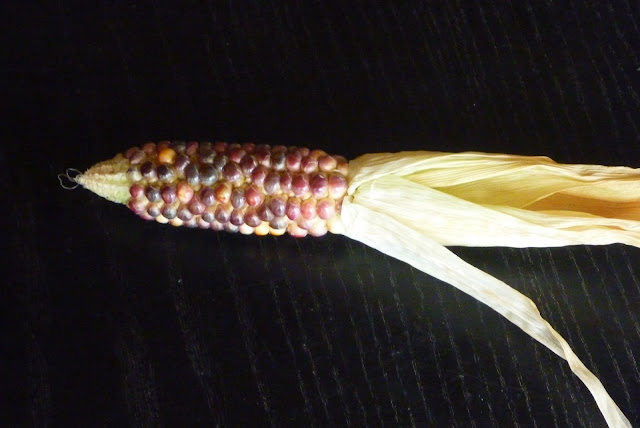
The lady who sold me the initial seeds said that she had been saving a multi-coloured "Aztec" corn and each year was keeping some of the more beautiful seeds and growing them separately to eventually make the glass bead corn variety.  As glass bead corn is a morph of the Aztec corn it is theoretically possible that it may morph back if no selective pressure is maintained for enough generations, but for now the two varieties are very distinct from each other.  I believe that one or more types of popcorn have added their pollen to the mix at some point in time.  I have grown the multi coloured Aztec corn in the past (I was trying to track it down when I found the glass bead corn) and it is easy to see that it and Glass Gem corn are now different varieties.


glass bead corn seeds for sale
Glass bead corn seeds

What can Glass bead corn be used for?


Sweet corn: I mentioned in my previous post that glass bead corn can be eaten as a sweet corn - but only if you get the timing right.  Both the Aztec and glass bead corn are a chewier version of sweet corn.  They are apparently sweet but firmer and with a deeper, fuller, more corny taste.  Sweet corn stays tender for about 3 weeks but is far sweeter when cooked within minutes of being picked as the sugars convert to starch reasonably fast.  You probably only get 5 days of tenderness with the glass bead corn before they start toughening up, again they would be sweeter if cooked immediately.  I am yet to eat it as a sweet corn as I am still trying to maintain as much genetic diversity as I can at the moment and selecting cobs after they have dried to hopefully breed it into something more amazing, I discuss that later in this post. 

Corn flour: Glass bead corn is excellent for cornmeal/flour as that is what its main ancestor, the Aztec corn, was bred for.  Yellow corn is relatively low in nutrients, white corn is lower than yellow in a few nutrients, but multi coloured corn is far higher in a host of different nutrients.  Corn flour made from yellow corn is yellow, when made from white corn it is white, when made from multi coloured corn it varies a lot.  While I am told that glass bead corn tastes nicer, I believe that this is due to freshness and the taste is much the same no matter what colour the corn is that made the flour.

Baby corn: Glass bead corn, just like any other variety of corn, can be used as baby corn.  While it will produce a crop of baby corn to use in stir fry or whatever, I think that there are better varieties to use for this purpose.  Varieties that have a shorter growing season, produce more cobs per plant, and grow shorter stalks are probably better suited to this task.

Decorations/teaching: Some people grow glass bead corn as decorations, I love the look of it but some people dislike the look of dry corn hanging on the wall.  As well as decorations some people try to teach genetics with it, personally I think that corn genetics are rather difficult and in depth (especially considering you are working with so many genes from parents of unknown lineage with a mix of alleles that may be dominant, co-dominant, recessive, transposons or retrotransposons etc I think that peas are far simpler for teaching genetics) so would not do this unless you are very confident with what you are doing or do not want to go too deep into the topic.

Popcorn: Glass bead corn can be used as popcorn, but it really isn't a great popcorn yet.  Some cobs clearly have popcorn as one or more of their ancestors as well as the Aztec corn.  I have grown mini blue popcorn in the past and can see several of its traits so figure that it is another of the ancestors of glass bead corn.  Sure a few kernels pop on every cob of glass bead corn, and on some cobs every seed will pop, but the strain that I grow has not been maintained or previously selected for popping ability.  There is wide genetic variation in the population in terms of seed colour, size of cobs, leaf/stalk/sheath/silk/tassel colour, and some cobs pop much better than others.

permaculture glass bead corn
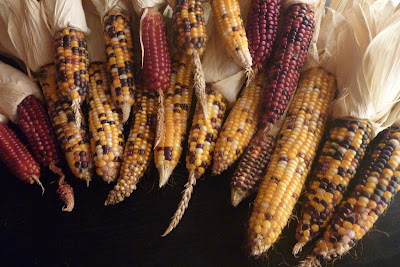
Glass bead corn - lots of genetic variation

How well does glass bead corn actually pop?

I think that a great popping corn could be selected from the existing gene pool and I am considering selecting and growing only the most colourful and best popping seeds.  But first I wanted to know how well glass bead corn popped in general.

If I chose the best cobs, pretty much all of the seeds will pop just like a variety that has been bred for popping, but that would not yield any useful data.  I wanted to see what percentage of a few random batches of all the seeds would pop.  This would most likely include seeds from the best cobs, seeds from the worst cobs, and seeds from average cobs.  I needed to do a few batches to give me a decent idea of how it pops. 

From randomly selected seeds (poured out of a large jar full of seeds mixed from all the cobs, and then counted) we found that an average of 24 out of 65 seeds did not pop well.  This is not a bad number already, certainly some packets of popcorn from the supermarket pop poorly like this, but it must be better if this is to be considered a good popcorn.

This means that currently only about 37% of seeds do not pop properly, which makes me believe that I can turn this into a beautiful and colourful popping corn in a few generations if I select for the popping trait as clearly the required genes are present. 

Australian glass bead popcorn
Glass bead popcorn - every seed on this small cob should pop

How to select for the popping trait

People ask me how I will turn this strain of glass bead corn into a better popping corn.  I normally tell them it is just by adding some selective pressure and growing the best seeds, many people comment that it sounds difficult.   If you have no interest in saving seeds or selecting corn to pop better the rest of this post is probably not for you and will be boring.

Adding selective pressure is actually a lot simpler than you may think.  Lets face it, whenever you save seeds from anything you are adding selective pressure whether you like it or not, I may as well add selective pressure for excellence in something rather than selecting for mediocrity in everything.  As there are currently no multi coloured popcorn varieties in Australia I may as well select for the popping trait and end up with a beautiful and useful variety of corn.

Firstly grow the seeds and let the cobs dry on the plant as best you can, then remove them and hang them somewhere to complete drying.  Discard any sweet corn seeds, glass bead corn has no sweet corn genes so this step has been done for you many generations ago.  These sweet corn seeds are easy to identify as they are wrinked and shrunken when dry, not firm and round and full like the glass bead corn.  The only way that Glass Bead corn will have any of this is if you or a neighbour are growing sweet corn and the pollen blows over the fence and pollinates your corn.  For anyone who is into genetics you are essentially removing the genes for sugary (SU), sugar enhanced (SE) and supersweet (SH2), once these genes are gone they will not pop up again by themselves.
multi coloured pop corn
3 of the darker cobs will pop well, the 2 with more yellow seeds will not

Selection Rules for popping corn

Once you have done that it is important to make some selection rules, mine are like this:

If many seeds on a cob are cracked I don't want to save the cob for seed (unless it has a colour or some other trait I desperately want to keep) and will discard it.  Cracked seeds will not pop as the pressure vessel is weakened or corrupted.  This seed is fine to grind into flour or feed to stock and are not noticeable if eaten at the milk stage (as a sweet corn).

I don't save the cob for seed if many of the kernels have popped on the cob.  This sometimes happens due to rain or irrigation, it is ok for sweet corn, it is fine if you are to grind it into flour, it is not great for animal feed due to lowering the storage time, but it is not a good sign for pop corn.  I normally get rid of the entire cob if any of the seeds have already popped as it appears to be strongly heritable.

Look at how the kernels are arranged on each cob, they need to be as round as possible.  They will not pop if they are flat or squished together.  They will also not pop well if the seed has an indentation on the top or if the kernel is angular instead of round.  Ideally the kernel would be spherical, as this is not possible in corn seeds you aim for the closest possible thing.

Look at each of the remaining kernels closely, if they look glassy and translucent then they probably will pop well, if they are not they tend to be poor at popping and should be removed.  As glass bead corn was created by selecting the prettiest glassy looking seeds of Aztec corn, the genes for glassy looking or translucent kernels are already present in glass bead corn.  The job now is to ensure that each seed is homozygous for glassy alleles and that each generation has a higher percentage of glassy alleles.

Each kernel must not have a deep indentation around the germ.  The germ needs to be small and reasonably indistinguishable if the seed is to pop well.  This trait is highly heritable so should be reasonably simple to select for.  The only down side is that if the germ becomes too small then survivability can be lowered.

If the individual kernels are overly large they will pop ok but will be tough, so I am selecting for regular sized kernels.  Small kernels seem to pop well, but do not give a lot of volume, people tend to want large fluffy popcorn in their bowl.  For this reason I will eventually aim more at growing medium sized kernels, but for now many of the small seeded corn cobs have all of the other traits so I am leaving a lot of them in.

I need to select seeds form a large number of cobs/plants as corn is highly susceptible to inbreeding depression.  Sometimes this will mean that I do not get the best popping corn traits as fast as I want to, but these set backs should only add an extra year or so to the project and ensure that this strain should be easy to continue indefinitely.

After all of this I then try to select for the best colours as well as a wide range of colours.  I have no intention of doing all this work to simply reinvent the wheel and ending up with a new type of yellow pop corn!  I was disappointed over how many yellow seeds are currently in the cobs, for the next few years I will not plant many yellow seeds so that the presence of the yellow allele is lower in the strain.   I also do not want to completely remove the yellow genes, I just want a smaller percentage of plants to carry yellow.

Larger cobs produce more seeds (which means more popcorn per plant), and plants that grow several cobs per plant are better use of space in the vegetable garden, and a shorter growing season means there is less chance for crop failure and more efficient use of vegetable garden space, but these are all secondary traits that are less important than the other traits mentioned above.  These traits can be selected for after the glass bead corn is a good popcorn, if you select for too many things you tend not to make any progress and the choice between what to keep and what to exclude becomes unclear.

After I have applied the selection rules I end up with a bunch of seed that is colourful, glassy looking, and reasonably round.  I then separate this into three batches (one to plant, two to store) to help make certain that I will not lose them if I have a bad year that results in crop failure.  Every seed that is culled or does not make it into storage/planting batches can then be eaten.  Each year I should move the glass gem corn towards being a better popping and more colourful corn.

In a few years we will see how I went, fingers crossed I end up with a refined strain of glass bead corn being an amazing multi-coloured popping corn reasonably quickly.  If that does not work I guess I could cross it with red pop corn and blue pop corn (to incorporate popcorn genes as well as adding some colour) and keep trying, but I have a good feeling that all the genes needed to make this into an amazing popcorn are already present.