Thursday, 18 October 2018

Red Fleshed Huonville Crab Apples

When we lived on acreage we had many apple trees.  We had three mixed orchards, each orchard had some apples.  We had some old heritage apples, we had over 50 espaliered apples consisting of four newer apple varieties.  We also had a few other things such as medlar.

Now we live in town we have far fewer fruit trees.  One I particularly like is the Huonville Crab Apple.  It is believed to be the cross between a domestic apple and a crab apple.  It grows small edible apples and is pretty enough to belong in an ornamental flower garden!  The apples are red fleshed, which is very rare in Australia, but it has other traits that I also like.

The bark of the Huonville Crabapple is a lovely dark colour.
Huonville Crab the branches are a rich dark colour
Domestic apples the branches are often more green
During the growing season the Huonville Crab apple leaves are a beautiful purple colour.  Most types of apple leaves are varying shades of green.
Huonville crab apple leaves
Most apple leaves are green
Huonville Crabapple flowers are a dark pink.  They are incredibly beautiful.  Before they have opened they look like tiny roses.  Most domestic apples are a pretty light pink/white when they flower.  While I like the look of both, and am glad to be growing both, I prefer the look of the darker Huonville crab apple flowers.
Huonville crab apple flowers look like roses before they open
Huonville crab apple flowers before they opened
Huonville crab apple flowers are beautiful
Huonville crab apple flowers
Most other apple flowers are pink and white and lovely

Cripps Pink apple blossom almost ready to open
The flesh of Huonville crab apple is red.  I will try to remember to take some pictures of them this year and put it up in another post.  Even the sap of the Huonville crab apple is purple.

I am quite taken by this tree.  The dark trunk, the purple leaves, and the stunning flowers look amazing together.  The dark red apples with red flesh are great, I think they would be better if the apples were just a little bit larger.

Tuesday, 16 October 2018

living mulch - do pumpkins shade the soil

Quite often I have read about the "three sisters" method of planting.  People state different reasons for each of the three plants being planted together.  More often that not people state that pumpkins are used as they shade the soil, and provide a living mulch.  But is this really the case?

First, let me say that the three sisters method works well when done properly.

If you grow field corn, dry beans, and pumpkins together they do crop well together.  The beans sequester atmospheric nitrogen that the corn appreciates, the corn provides a stalk for beans to grow up but more importantly the corn exude sugars into the soil for the pumpkins, the pumpkins are meant to shade the soil, but they don't.  Or at least they don't shade the soil when it is hot.

If you have ever stopped to look at pumpkin leaves on a cool day they are large and cast an impressive shadow.  If you look at them during any kind of heat you may notice that they go flacid to conserve water.  When they are flacid they do not cast much of a shadow and do little to cool the soil.

When we lived in Central West NSW we had about 9 weeks each year where the day time temperature exceeded 40 C.  It was incredibly hot and dry for a very long time.  Pumpkins were all but worthless for providing shade in that kind of heat.  The leaves would go flacid at about 7:30 each morning and stay that way until they were watered in the evening.  It kept them alive, I got a crop out of them, but didn't help the corn.

I know that people will argue with me on this, so I took some pictures to demonstrate my point.  I took these pictures last summer on a day that reached 30 C.  It was a still day with no wind.  If pumpkins don't cast shade on a day like that they are not going to do a great deal in any real heat or if it is windy.
Pumpkin leaves in any heat wilt badly, but do they still cast much shadow?
Pumpkins from this angle you can't tell if they shade the soil
Pumpkin leaves, look how little shadow they cast at 30 C
I have had people argue this point with me and say that in the three sisters method that there is plenty of shade on the soil.  This is partly true.  In the three sisters method there is often plenty of shade on the soil, but it is not due to the pumpkin leaves.  Look at the picture above, pumpkin leaves don't cast much shade at all when the days warm up.  They cast even less shade when it is hot.

I think the shade that may be due to the corn.  So I took some pictures of the soil under my corn plants.  It was the same day as I took the pumpkin pictures, it only reached 30 C and there was no wind.  On hotter days the shade under corn plants is much the same as their leaves curl but don't wither away like a pumpkin.

Corn plants (on the left) cast more share than pumpkins (ignore the potatoes on the right)
The three sisters method works well when done properly, but what about when you want to shade soil under other tall crops such as yacon?  If you want a plant to shade the soil what should you use?  As you can see in the pictures above pumpkins are not very good at shading the soil unless the day is cool and still.

In the past I have attempted to use things such as clover.  This is not great, it survives cool weather and appears to die in the heat.  No matter how much water I gave it the clover always died in Central West NSW over summer.  I need something that stands up to the heat of summer, grows densely to shade the soil, but does not get too tall.

I have successfully used purslane to shade the soil under corn and a few other crops.  This worked perfectly, it survived the heat, if watered it produced a thick deep mat, it did not appear to compete with the corn, it self seeded and dies at the end of summer.  It is edible by people as well as other animals.  Purslane apparently contains highest amounts of omega 3 fatty acid of any plant we know of and is very healthy for poultry.

Some people view purslane as a weed, and it self seeded so I more encouraged it rather than controlled where and when it would grow, so I looked for other options too.

I trialed strawberries as a ground cover to shade the soil.  I grew an alpine strawberry that produces a lot of runners.  This produced a thick ground cover that had the benefit of producing delicious edible strawberries.  The strawberries are a short plant, have a relatively shallow root system, and do not appear to compete very much with taller things.

Yacon with strawberry ground cover so dense the soil is completely shaded
Strawberries shade the soil even on hot days - note the strawberries ripening in the background
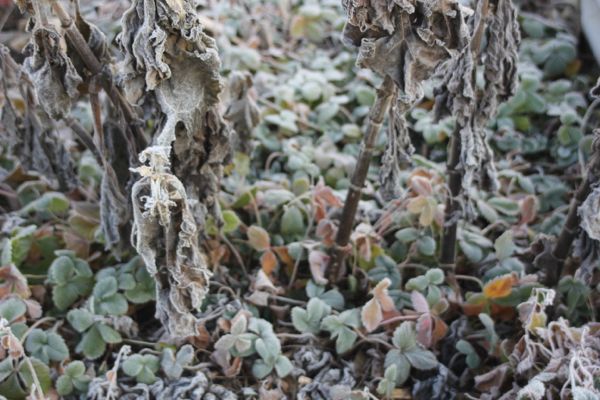
They also protect the roots from frosts a little
Growing strawberries as a ground cover worked well during the growing season.  Strawberries need a bit of water to survive, but so did the yacon so it wasn't a problem.

When it came time to dig the yacon it was less than ideal as I also had to dig the strawberries.  The strawberries are pretty hardy and survived being dug pretty well so it wasn't too much of an issue.

I do wonder if I could grow something like a creeping thyme as a ground cover.  I may try a few different things and see how they work.

Wednesday, 3 October 2018

Hybrid fruit: real and imaginary

There are some amazing hybrid fruits around, things such as plumcots (which are a cross of a plum and an apricot) or boysenberries (which are the cross of raspberry and blackberry) or jostaberry (which are a cross between a black current and a gooseberry) are rather well known.  Others are virtually unknown.

Most of the more well known hybrids are crosses of different species, others are crosses of different genus.

Sometimes people get confused by what does and does not cross, so sometimes there is confusion.  Other times people deliberately sell fake seeds and plants with made up histories.  I thought I would write a post showing some of the real hybrids as well as some fake hybrids.


Pear x Apple hybrids - Real hybrids and Imaginary hybrids

There seems to be a little confusion over intergeneric apple (Malus) x pear (Pyrus) hybrids.  There are a lot of common names that confuse people.  Apple x pear hybrids can and do exist, but they have not become marketable yet.  Perhaps one day they will.

Let me show you ome that are not hybrids and why they confuse people, then I will show the real apple x pear hybrids.

'Papple'
The Papple is a hybrid of an European pear Pyrus communis and an Asian pear Pyrus pyrifolia and was originally named “T109” by breeders.  It is a hybrid of two species of pear.  The papple is NOT a cross between a pear and an apple, it has no apple in its genetic makeup whatsoever.  The papple is a pear that has the vague appearance of an apple, so it was named 'papple'.

Papple is a cross between European pear and Asian pear, it is NOT a hybrid pear and apple

Friday, 14 September 2018

How Seedless Watermelons Work (And Why They Still Have Seeds)

Seeds in seedless watermelon - how is this possible

Have you ever eaten a seedless watermelon and found 2 or 3 black viable looking seeds?  Have you ever wondered how this is possible?  I have.

I have a good understanding of how seedless watermelons are made.  Theoreticaly it is impossible for black viable seeds to form in a seedless watermelon, yet on occasion they do form and they are viable.  It irritated me not knowing how this is possible. 

I searched the internet to find out how it was possible for a seedless watermelon to produce black viable seeds.  Strangely enough I couldn't find any explanation.

I spoke to/emailed some plant nerds and a certain professor at a university who asked I didn't name him (and I won't - wink) and I now understand how seedless watermelons can produce black viable seeds.

If you would like to read a simplified version of how seedless watermelons can produce viable seeds then keep reading.

If you are a plant geneticist and would like to elaborate on any points that I have simplified too much, or anywhere that I have strayed a bit too far and confused things, then feel free to leave a comment!
Watermelon grown from a viable seed from a seedless watermelon

Quick answer: Can seedless watermelon have seeds?

Yes, occasionally a seedless watermelon can contain a black seed. Most of the seeds inside are immature white seeds, but rare mature seeds can occur due to how the fruit develops.  The question you are asking yourself now, is how is it possible for seedless watermelons to produce viable seeds?

How are seedless watermelons made

First you need a basic understanding of how seedless watermelons were made.  To understand how seedless watermelons are made you need to understand a little about ploidy.

Haploid

Haploid refers to the number of chromosomes in a gamete.  This is usually half the number of chromosomes that are carried in a normal cell.  Pollen, for example, is haploid.


Diploid

People (and most animals) are diploid, meaning we have two sets of chromosomes in each cell.  We get one set from our mother, and one set from our father.  This is simple.  This is how people can carry recessive genes for things and pass them onto their children.

Many watermelons are also diploid, meaning they have two sets of chromosomes in each cell.  In watermelons n = 11, in other words a diploid watermelon will have 22 chromosomes in each cell (two sets of 11 chromosomes).

When haploid pollen is produced in a diploid the chromosomes need to pair up, in other words we need to halve the number of chromosomes.  1/2 of 22 = 11, this is a whole number so the pollen is viable. 

If a diploid watermelon gets pollinated by a diploid watermelon then the resultant seeds will grow into diploid watermelons.  They will get one set of chromosomes from the mother and one set of chromosomes from the father.


Tetraploid

Years ago people discovered how to induce polyploidy in plants.  Polyploidy means they are carrying more than two homologous sets of chromosomes.  After we learned to induce polyploidy in plants some tetraploid watermelons were produced.

Tetraploids carry four sets of chromosomes, they get two sets from the mother and two sets from the father.  Tetraploid watermelons have 44 chromosomes in each cell (four sets of 11 chromosomes).

When haploid pollen is produced in a tetraploid the chromosomes need to pair up, in other words we need to halve the number of chromosomes. 1/2 of 44 = 22, this is a whole number so the pollen is viable.

If a tetraploid watermelon gets pollinated by a tetraploid watermelon then the resultant seeds will grow into tetraploid watermelons.  They will get two sets of chromosomes from the mother and two sets of chromosomes from the father.


Triploid
This is where things start to get tricky.  Triploid watermelons have three sets of chromosomes.  Triploid watermelons are created by crossing a diploid with a tetraploid.

Triploids get one set of chromosomes from the diploid father and two sets of chromosomes from the tetraploid mother.  Triploid watermelons have 33 chromosomes (three sets of 11 chromosomes).

In animals this is often lethal, but in plants it usually isn't.  If you plant these triploid seeds they grow and flower but can not normally produce viable pollen.

When haploid pollen is produced in a triploid the chromosomes need to pair up, in other words we need to halve the number of chromosomes.  1/2 of 33 is not an even number, so the chromosomes can't pair, which usually renders the pollen infertile.

Watermelon fruit will abort if the flower is not pollinated.  For this reason a triploid watermelon needs to be pollinated by a diploid watermelon to produce fruit.  As the triploid has an uneven number of chromosomes the seeds usually abort early, leaving you with those white empty non-viable seeds.  Thus a seedless watermelon.  This was an amazing breakthrough when it was first achieved by the University of Kyoto.

If you ever grow seedless watermelons at home (why would you bother, they are more bland than seeded varieties) you will have two packets of seeds.  You will have seeds of the triploid watermelons that will bear seedless fruit, and a pollinator variety which will be a diploid.


How does a seedless watermelon ever produce viable black seeds

Now that you have a basic understanding of how a seedless watermelon is produced we can get back to the initial question of how do seedless watermelons produce black seeds.  There are a few scenarios that can happen, one is far more common than the others.

The most common situation is where during meiosis (specifically the prophase 1’s third ‘pachytene’ pairing stage of cell division) a triploid cell does not have an even number of chromosomes to pair properly.  Remember the 1/2 of 33 thing from earlier, it just doesn't work.

During that stage, under some conditions, the triploid cell will double making it hexaploid with six sets of chromosomes instead of the three a triploid would normally have had.  Hexaploid have 66 chromosomes (six sets of 11 chromosomes).

When haploid pollen is produced in a hexaploid the chromosomes need to pair up, 1/2 of 66 = 33, this is a whole number so the gamete is viable.

This hexaploid embryo carries three sets of chromosomes in its haploid state.  If it is pollinated by diploid pollen (which in its haploid state carries one set of chromosomes) the seed produced is viable!  In this case the seed would receive one set of chromosomes from the (diploid) father, and three sets of chromosomes from the (~partially hexaploid) mother.

If you were to grow this seed it would be tetraploid plant, carrying four sets of chromosomes.  This tetraploid then grows just like any other tetraploid.

If I grow out this tetraploid seed and it self-pollinates (or is otherwise pollinated with tetraploid pollen) the seeds will grow into tetraploid plants with seeded fruit.  Just like any other tetraploid, seeds would gain two sets of chromosomes from the mother and two sets of chromosomes from the father.

If I grow this tetraploid and it is pollinated with a regular diploid then all the seedlings will be triploids which would then be able to be seedless.

Some other scenarios where seeds are produced in seedless watermelons

There is a far less common scenario where during meiosis a set of chromosomes is mysteriously lost.  This happens, but not very often.  When this happens the cell essentially becomes diploid which can then produce a haploid gamete.   If self-pollinated, or if pollinated by another diploid, the resultant fruit will have seeds and the plants will remain diploid.  This is extremely rare, so you would need to grow out a lot of seeds in order to have a chance of seeing this happen.

Another thing I have been told of is spontaneous mutations.  There are various mutations that could cause a triploid to produce seed, these would be very rare and are not really discussed in literature so anything I could say on them would be largely guess work on my part.  Based on their rarity, I don't expect to ever see one of these in my life.


Seedless watermelons - why do people sell them

While they don't bother me, many people dislike watermelon seeds.  For some reason there is an old myth that you can't eat watermelon seeds or they will hurt your stomach.  I just eat the seeds along with the flesh.  They are small so easy to swallow, they have never hurt my stomach.  Strangely enough customers disliking the seeds is not the main reason that you can only find seedless in the stores.

Triploid (seedless) watermelons are not all that round, they are more angular with flatter sides so tend not to roll as easily.  Diploid watermelons are often rather round (or oblong or whatever other shape you want to call them, the point I am trying to make is that they roll easily) and have a bad habit of rolling.  Losses due to rolling off a counter and smashing have been reduced now that triploid watermelons are sold.  This is good for profits.

More importantly than that, triploid watermelons can be stored for many months more than diploid watermelons.  They can be sent across the country and stored in a warehouse for months before needing to be sold.  This is good for business and great for profits.  It also means that customers can get 'fresh' watermelon out of season.
 

What now

I am now collecting viable seeds from seedless watermelon that in the hopes of growing out a tetraploid watermelon.  I have never eaten a tetraploid watermelon before so am curious to see if it is as bland as the triploid ones or if it tastes as good as an old fashioned diploid.

I am also curious to see if tetraploid fruit is round like a diploid or more angular like a triploid.  Or if it is as simple to grow as a diploid, or if it has issues like triploids tend to have.

While I am curious, I won’t be testing the keeping ability to see if it lasts for many months like a triploid. 

If I grow one out to maturity and get to eat the fruit I will try to write a post comparing its growth, yield and taste to a diploid watermelons.

More Unusual Plants and Food Experiments

If you enjoy learning about unusual crops, forgotten foods, and the interesting ways plants grow, you might also enjoy these articles:

I enjoy growing and experimenting with plants that are a little different from the usual garden crops. Sometimes the most interesting plants are the ones that have been forgotten or overlooked.


Wednesday, 5 September 2018

Guinea pigs to mow the lawn

I broke my spine a few years ago.  I can walk which is lovely and I appreciate the time I have had being able to walk.  I have known people to break their spine in a similar way to me and never walk again, so I count myself lucky.

My back is degrading, every day seems to be worse than the previous one.  Each time I mow the lawn I wonder how many more times I will be able to mow.  My kids are getting older and more capable, but none of them are able to safely use a lawn mower.  I am struggling to even use the ride on mower lately.  I got rid of some lawn and replaced it with vegetable beds, but I still have some lawn for the kids to play on.

This got me thinking, why mow the lawn at all?  Why not get something that eats grass to mow the lawn for me?

We are not on acreage any more so my options are limited.  Large livestock such as sheep or goats or cattle or alpacas are no good here as they would eat the fruit trees, they would eat the vegetables, and due to the size of my block eventually we would be left with nothing but dust and poo.
Sheep are great on acreage, not great for a backyard

Sunday, 26 August 2018

Aji Amarillo

I like chillies.  I enjoy their capsaicin, but far more than that I love their taste.  There are literally thousands of different types of chillies and each of them tastes different.  Some are sweet, some bitter, some fruity, some citrusy, some savoury, some earthy, some dirty and I dislike them.

Unfortunately the markets only provide few varieties of chillies, so few that most of the foodies I know have no concept of the many thousands of varieties that are out there.  This means if I want to taste something remarkable I must grow it myself.

My vegetable garden is feeling small as there are so many amazing vegetables that I can't buy and have to grow myself.  I grow everything organically and I save seeds with my kids.

This year I grew very few chillies.  One that I grew this year was Aji Amarillo (Capsicum baccatum) which is a lovely chilli from Peru. 

Aji Amarillo e translates to "yellow chilli", aji means chilli, amarillo means yellow.  When dried it is known as Aji Mirasol (which I am told means "looking at the sun" but I don't really understand how).
Aji amarillo - many were longer than this

Wednesday, 22 August 2018

Raised Vegetable Beds: Turning an Unused Lawn Into a Productive Garden

I turned an awkward, sloping patch of lawn into raised vegetable beds and used the space to grow vegetables, herbs, berries and flowers.  The raised beds made the area far more productive while reducing bending, digging, and weeding.  Eight years later, the beds are still in excellent condition.

What is more useful, this odd shaped piece of grass on a gentle slope which fits a guinea pig house nicely and takes time to mow every now and again?  Or a jungle of many different organically grown fresh herbs and vegetables?

An awkward patch of lawn doesn't necessarily need to remain lawn.  In my case, converting the lawn into raised vegetable beds created considerably more useful growing space without increasing the overall footprint of the garden.

2026 update: 8 years later These raised vegetable beds have now been in use for eight years.  They are still in excellent condition and continue to be a productive part of the garden.  What started as an awkward, difficult-to-mow patch of lawn has become a productive growing area for vegetables, herbs, berries, and flowers. 


The odd shaped piece of lawn before was not very useful
Raised vegetable beds, they look great plus they produce organic food

Let's take a look from another angle.  Here is the odd shaped piece of lawn again.  It was wasted space that took time and effort to mow.  The lawn clippings were useful in the compost and the weeds that grew in there attract beneficial insects, but other than that it had little use.  

I took a photo before vegetable beds, then I stood in much the same spot and took a photo after the raised vegetable beds were installed.

The awkward patch of lawn before it was converted into raised vegetable beds
The patch of lawn before converted into raised vegetable beds

The same area after conversion to raised vegetable beds, now producing vegetables, herbs and berries
That same small patch of land overflowing with fresh organic vegetables

Let's have one last look, I stood in much the same spot to take both pictures for comparison purposes.

Guinea pig house protecting vegetable seedlings from birds on the odd shaped plot of lawn

The same plot with lawn killed, guinea pig house moved, and raised vegetable beds installed

Don't make any mistake here, it took some work filling the beds with soil, planting seeds and seedlings, watering etc.  All of that work is more than worth while.  The raised vegetable beds became very productive very fast.  Being raised beds means I don't have to bend as much, which is easier on my back.  

If you read my blog you will see that I grow many rare vegetables as well as dabble in vegetable breeding.  I can still do this because we converted a wasted lawn into a reasonable sized vegetable garden.  These raised vegetable beds are great, they mean far less bending, less digging, less weeds and less work.

I largely grow perennial vegetables, berries, and edible herbs in these raised garden beds, which can be particularly useful in a productive home garden because they don't need to be replanted every year.  Getting up off the ground has also meant fewer weed issues.

Planting seeds and seedlings
Look how neat and tidy they all look
Even at this early stage they were productive

It didn't take long before that almost worthless piece of lawn became a jungle of delicious organic vegetables, amazing berries, fresh herbs, and a few pretty flowers for the kids.

Many people have never eaten fresh food.  Some foods are too soft to transport, so they are picked not yet ripe and can never taste their best.  The sugars in sweet corn convert to starch noticeably within 15 minutes of being picked.  If you want fresh food you must grow it yourself.  Food from the markets is not fresh and it will never be as good as food you can grow on an otherwise useless piece of lawn.

All of this fresh organic food had zero food miles, it was watered from the water tank which collected water from the roof, it was fertilised with compost made from lawn clippings and chicken manure from my property.  Does it get any better than this, yes it does!

To make things better my kids know where food comes from as they help me plant seeds and tend the vegetables, they help harvest and eat the food, and they help me save seeds (and dabble in a little plant breeding) each year.  Most adults I know have no idea how to save seeds. 

My kids have grown and eaten many fruit and vegetables that most people have never heard of.  They have eaten delicate and tender foods that could never survive transport.  All of this is possible because we destroyed a weird shaped part of our lawn and made it into something better.

Many vegetables are growing here
Raised vegetable beds - far more productive than lawn

Was converting the lawn into raised vegetable beds worth it?

Absolutely.  What was once an awkward patch of lawn that needed mowing became one of the most productive parts of the garden.

The raised beds gave me more usable growing space without needing a larger garden.  They are easier to work in than the original ground, require less bending and digging, and make it possible to grow a surprisingly wide range of vegetables, herbs, berries, and flowers in a relatively small area.

The biggest test is time.  Eight years after building the beds, they are still in excellent condition and are still producing food.  Looking back, I would much rather have a productive vegetable garden producing rare and incredible types of food, than spend those years mowing an awkward piece of lawn.