
 |
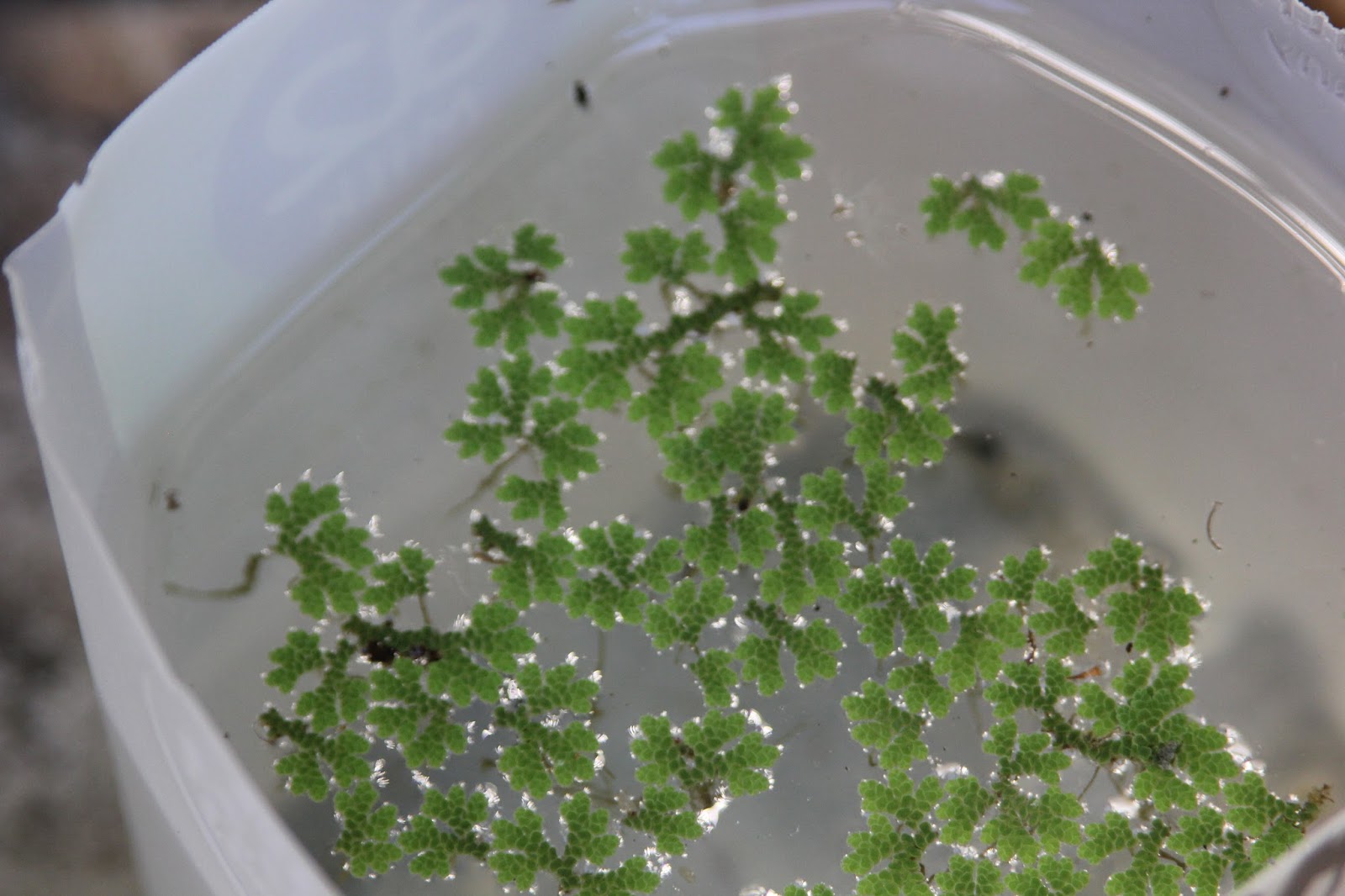
| Azolla starting to cover the water surface |
Quite often people speak of azolla’s ability to control mosquitoes by it forming a dense mat which reduced the ability of the larvae to reach the surface to breathe, theoretically suffocating them.
I have read no evidence of azolla reducing the survival of immature mosquito larvae of any of the species of mosquitoes that are common in Australia.
I have read a few experiments which have tested the suffocation theory using some of the species of mosquito that are common in Australia as well as one of the species of azolla that is common in Australia. None of the studies I have read indicated that larvae respiration was hindered by azolla in any way. All the studies I have read indicate that mosquito larvae either find a naturally occurring gap or simply push their breathing tube up between the azolla as if it wasn’t there. Poking a snorkel up through azolla also protects them from being seen by predators! Never listen to anyone who says that mosquitoes are suffocated by azolla, they have not done any research and are talking nonsense.
Having a few azolla plants floating here and there with mostly open water does nothing to control mosquitoes.
Now that the ways in which azolla does not control mosquitoes is out of the way let’s look at how azolla can and does help to control mosquito populations.
I have read no evidence of azolla reducing the survival of immature mosquito larvae of any of the species of mosquitoes that are common in Australia.
What azolla does not do
I have read a few experiments which have tested the suffocation theory using some of the species of mosquito that are common in Australia as well as one of the species of azolla that is common in Australia. None of the studies I have read indicated that larvae respiration was hindered by azolla in any way. All the studies I have read indicate that mosquito larvae either find a naturally occurring gap or simply push their breathing tube up between the azolla as if it wasn’t there. Poking a snorkel up through azolla also protects them from being seen by predators! Never listen to anyone who says that mosquitoes are suffocated by azolla, they have not done any research and are talking nonsense.
Having a few azolla plants floating here and there with mostly open water does nothing to control mosquitoes.
Now that the ways in which azolla does not control mosquitoes is out of the way let’s look at how azolla can and does help to control mosquito populations.
 |
| Azolla at this density may not make much difference yet (did you see the mosquito on the right) |
How azolla actually reduces mosquitoes
Having a complete surface mat of azolla covering the entire surface of the water does make a difference to the numbers of mosquitoes. In some species of mosquito this azolla mat significantly lowered or even completely prevented ovipositing (egg laying). In other species of mosquito these azolla mats did not prevent or reduce ovipositing at all. This means that the number of some species of mosquito will be lowered as less eggs have been laid. This is a good start, but azolla does more than that!
For mosquito pupa to undergo metamorphosis and emerge into an adult flying insect it needs some room at the water surface. In all of the studies I have read a thick mat of azolla (this could be a continuous mat down to only 2/3 coverage) significantly reduces the emergence of adult insects.
For mosquito pupa to undergo metamorphosis and emerge into an adult flying insect it needs some room at the water surface. In all of the studies I have read a thick mat of azolla (this could be a continuous mat down to only 2/3 coverage) significantly reduces the emergence of adult insects.
I am sure there are exceptions to this and there are probably some species that are not bothered, but in all of the studies I have read azolla mats significantly reduce mosquitoes emerging as adults. In one study continuous azolla mats caused 42–85% mortality at adult emergence. This mortality at emergence, combined with the lower number of eggs being laid, can lead to a rather significant reduction in the local mosquito population for a short time.
Azolla controls mosquitoes naturally
The way in which azolla helps to control mosquitoes is important.
If azolla suffocated larvae, much like when people put oil on water, it would also suffocate many insect predators that also breathe air. In Australia we have many predators such as diving beetles and water scorpions that can eat mosquito larvae and also need to breathe air. As azolla does not suffocate insects it means that the background populations of predators like this are still there, meaning that the ecosystem is healthier. Another benefit is that predators like this are actively hunting the remaining mosquito larvae and helping to further reduce the mosquito population.
As mosquito larvae are not suffocated by azolla it means that any small fish who naturally eat them are still going to have access to food. Again this means that the ecosystem is healthier, and it means that these fish will survive and predate on the remaining larvae.
Having a background population of predators ensures that some form of control will be there for the times of year that inevitably the azolla cover is not present. Sooner or later mosquitoes will fly in from somewhere else, or the wind will blow them over, and it is important to have predators waiting for them.
If azolla suffocated larvae, much like when people put oil on water, it would also suffocate many insect predators that also breathe air. In Australia we have many predators such as diving beetles and water scorpions that can eat mosquito larvae and also need to breathe air. As azolla does not suffocate insects it means that the background populations of predators like this are still there, meaning that the ecosystem is healthier. Another benefit is that predators like this are actively hunting the remaining mosquito larvae and helping to further reduce the mosquito population.
As mosquito larvae are not suffocated by azolla it means that any small fish who naturally eat them are still going to have access to food. Again this means that the ecosystem is healthier, and it means that these fish will survive and predate on the remaining larvae.
Having a background population of predators ensures that some form of control will be there for the times of year that inevitably the azolla cover is not present. Sooner or later mosquitoes will fly in from somewhere else, or the wind will blow them over, and it is important to have predators waiting for them.
Final thoughts on azolla and mosquitoes
Make no mistake here, growing azolla (or doing anything else) will never completely eradicate mosquitoes. The best you can hope for is that the mosquito numbers at your house will be low enough that they don't bother you.
Azolla is an extremely useful floating fern for the permaculture garden. I use it for many purposes, including as a fertiliser and feeding to poultry.
Some species of azolla are native to Australia, or at least it has been established here so long that we consider it to be native. If you want some azolla I sometimes sell azolla through my for sale page.
Some species of azolla are native to Australia, or at least it has been established here so long that we consider it to be native. If you want some azolla I sometimes sell azolla through my for sale page.

No comments:
Post a Comment