Showing posts sorted by relevance for query thornless. Sort by date Show all posts

Sunday, 22 July 2018

How to prevent thornless berries reverting to thorny

Thornlessness in brambleberries appears to be influenced by at least three different factors.  Scientists and plant breeders have understood these factors reasonably well for quite some time.  Each of them has different advantages and disadvantages.   But how do you keep a thornless berry thornless, and how do you prevent a brambleberry from reverting to being thorny?

First, let me tell you about my experience growing a "thornless youngberry", then let me explain the three different ways that brambleberries can be thornless, then I will explain what you do about each of the three types.
Thornless youngberry starting to ripen

Saturday, 3 March 2018

Days to maturity Chester Thornless Blackberry

One of the berries I grew this year was a thornless blackberry known as 'Chester'.  Chester is meant to be one of the tastier and more cold hardy of the thornless blackberries.

Unlike some of the varieties of thornless blackberry such as Waldo, Chester is said to be relatively productive and tasty.  Also unlike many varieties of blackberry it is legal to grow, sell, propagate, distribute etc Chester blackberries in NSW.

Unfortunately the heat hit at the wrong time and we lost most of the berries, hopefully next year when the plant is larger we get a larger crop. They do taste good, but I far prefer my thornless youngberries.

Days to maturity Thornless Chester Blackberry (Rubus fruticosus species aggregate)

Seeds planted       N/A grown from divisions
Germinated           N/A
Flowered              26/11/2017       Day 0
Fruit Ripe              06/01/2018       Day 41

Saturday, 13 January 2018

Days to maturity Thornless Youngberry

One of the berries I grew this year was a thornless youngberry.

Youngberries are one of the many hybrid berries that have raspberry and blackberry in their parentage.  These are not GM, the first ones were bred about 100 years ago.

These things taste amazing, much like a boysenberry, but are smaller and more productive.  They have no thorns on the canes (botanically they are known as prickles) and are strong vigorous growers. 

Days to maturity Thornless Youngberry (Rubus sp)

Seeds planted       N/A grown from divisions
Germinated           N/A
Flowered              25/10/2017       Day 0
Fruit Ripe              07/12/2017       Day 43

I have added this to a larger list of vegetable days to harvest from seed.
Thornless youngberry

Thornless youngberry

Friday, 10 December 2021

Living-Mudflower Original Vegetables - Creating My Own Unique Varieties

Over the past few decades I've been breeding my own vegetables, herbs and fruit by deliberately crossing different varieties and selecting the best offspring over many generations.  This page introduces some of the original varieties I've developed and explains the goals behind each breeding project.

Breeding your own vegetable varieties is something many home gardeners never attempt, but it is one of the most worthwhile parts of gardening.  Unlike buying seedlings, or saving seed from a commercial variety, intentionally breeding your own plants allows you to select for traits that matter in your own garden, such as flavour, productivity, early maturity, or resilience.

Over many years I have experimented with hand pollination and cross breeding vegetables, herbs, berries, and other plants.  Some varieties have become stable enough to share, while others are still evolving.

Over many years I have deliberately hand crossed different varieties of vegetables and selected the most promising offspring over successive generations.  My goal isn't simply to save seed or to add selective pressure, but to combine desirable traits, such as flavour, productivity, colour, disease resistance, or adaptation to my local climate, and stabilise these into new and unique varieties.  

Why Exclusive Plants No Longer Impress Me

I used to look at online plant shops at all the plants they had that were claimed to be 'exclusives'.  That used to impress me.  Then, one day one of these places bought plants from me and started selling them as their exclusives.  One of these places talks about saving heirloom vegetables, yet often renames things and then claims that they are exclusive to them.  I am no longer impressed in the slightest when I see claims of plants or seeds as being exclusive. 

Very few online plant shops carry things that they have developed themselves.  I am far more impressed by this as breeding a new variety takes years of dedication. 

My Unique Home Bred Varieties: how to create a new vegetable variety

Most of my breeding projects began with deliberate hand pollination between two carefully chosen parent plants, followed by several generations of selection and back crossing and culling.

I breed these new vegetable varieties, and improved herb varieties, and berry varieties, and fruit varieties etc myself at home with limited resources.  Some varieties are listed below while others are not yet stable enough to list here.  

Some are named, while others still need to be named.  Maybe I should have a competition of some sort one day to name some of my new things.

Some of these will be available through my for sale page, while others are not ready yet or out of season.  Everything I grow is organic, I don't even use the poisons that are certified to be used in organic farms.

Why Breed Your Own Vegetable Varieties?

Plant breeding is the process of crossing plants with desirable traits, selecting the best offspring with desirable traits and growing future generations from them.  Over time, gardeners can create unique plants that are better suited to their own climate, soil, and needs.

Unlike cloning a favourite plant through cuttings or division, cross pollinating and growing from seed introduces genetic variation.  This variation is what allows new combinations of traits to appear.

Sometimes I start breeding a new variety with a certain set of traits in mind, choose parent plants with these traits, and cull heavily.  Other times I have something vague in mind and throw as much diversity in the mix as possible and search future generations for desired traits.  It is kind of like art, but instead of painting with colour, I work with genetics.  The results are not only beautiful and colourful, but can also be more productive, more nutritious, more fragrant, more resilient, or simply more delicious.

Original Vegetables developed by Living-Mudflower

Igloo tomato: A Compact High Production Early Tomato for Small Gardens

'Igloo' tomatoes were the first tomatoes I ever bred.  I had limited access to germplasm, a basic understanding of cross pollination, at the time I was young with only a rudimentary understanding of genetics and no one to guide me, yet I was still able to get a great end result.  

Igloo tomatoes are short stout little plants somewhere between one and two feet tall, small red round tomatoes that are very uniform in size and colour.  They taste ok if picked and eaten early, but taste far superior if left to fully ripen.  Large seeds make seed saving simple.  Great for small spaces or short seasons as it is one of the first to ripen and produces over a long period, and they are incredibly high yielding usually producing 10kg to 12kg of tomatoes per plant in my garden. That is a tremendous amount of tomatoes for such a small plant. 

Igloo tomato Australia
Igloo tomato


Nanuq Tomato: Compact, Great Flavour, Lower Yielding Variety

'Nanuq' was another of the first tomatoes I bred back when I was very young.  Small wimpy looking but surprisingly strong plants, small red round tomatoes produced on plants that are about a foot tall.  These have wispy carrot like foliage that were bred for taste and early ripening.  Nanuq tomatoes are one of the first tomatoes to ripen and only takes up a little space.  I’m not blown away by the size of the crop but it makes up for that with the taste. 

Nanuq tomato Australia
Nanuq tomato
 

Immali Corn: Purple/White Coloured Sweet Corn

'Immali' corn is a pink/purple and white sweet corn.  I believe this is the first purple sweet corn to have been developed in Australia.  This purple sweet corn is healthier than yellow corn as it is high in antioxidants, and better tasting than any store bought corn.  Reasonably short plants around 5 feet tall, most tiller to some extent, they produces numerous cobs per plant but is highly dependent on spacing and soil fertility.  Sweet corn with su se+ genes means it is best suited for backyards rather than market gardens as cobs don’t store anywhere near as long as the Sh2 varieties, but they have a superior taste.


Immali corn
Immali corn - purple sweet corn

Immali corn - dry seeds for saving

Amiah potato (pronounced 'uh-my-uh' often autocorrected to Amish)

Very few home gardeners have ever grown a potato from true seed, and even less have cross bred potatoes and selected for an improved variety.  

In my opinion 'Amiah' potatoes are the best of the best of diploid potatoes.  They have the great taste of a diploid potato without having the low yields that are common among diploids.  The size of potatoes is small but reasonable, they don’t need peeling, and each plant produces crops that are good but not as large as many tetraploid varieties.  Amiah potatoes are healthier to eat and better looking than white potatoes due to its rich yellow flesh and interesting skin colour.  

Amiah potatoes have a great taste, easily produce two crops per year here, are quite stubborn/aggressive in its spreading, and always survives over winter in the soil with no extra care from me.  

As well as all this they produce huge numbers of beautiful purple flowers on long stalks held high above the foliage.

Amiah potato comparison
Amiah potato and white tetraploid potato for comparison

Amiah diploid potato
Amiah potato and white tetraploid

Oaken (dwarf multiflora) tomatoes 

These produce dwarf plants with regular leaf.  Flowers are produced in clusters of about 150, but not all of the fruit sets in my garden and many of the flowers fall off.  The fruit is small, mostly round, and light orange often with some green stripes.  It has a sweet taste and is surprisingly late to ripen for such a small fruited tomato, but once it does ripen it crops until killed by the frosts as it is an indeterminate dwarf tomato.

The colour is off in this photo, they are darker orange than this
One truss of dwarf multiflora tomato flowers

Tracey tomato (black yellow/green when ripe)

'Tracey' tomatoes are the result of a more recent breeding effort, where I had greater understanding of genetics, more access to germplasm, but far less time to put into the endeavor than many of my earlier breeding attempts.  The plants produce tasty little tomatoes that are intensely black where sun hits the fruit, yellow/green under the black.  Tracey tomato produces the darkest true black tomatoes that I have ever seen.  The black is from the high levels of antioxidants, which make this a very healthy tomato to eat.  They have green flesh when ripe, and taste incredible.  Unripe tomatoes are beautifully purple, similar to an eggplant.  

Tracey tomatoes are very productive, producing mostly round ping pong sized fruit, but are not completely uniform and never will be.  This variety has produced well for me in hot dry summers, in mild wet summers, in dust storms, through drought, as well as during lovely mild years.  Ornamental, highly productive, with great taste makes these a great variety to grow.
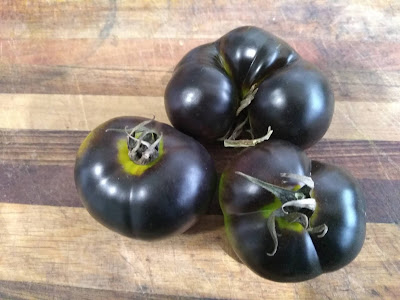
Tracey tomatoes
Ripe Black Yellow/Green tomatoes
Unripe Tracey tomato

Unnamed Varieties

Genetically Thornless Primocane Red Raspberry 

This is a dual cropping, thornless, red raspberry.  This variety is sweeter than many red raspberries and is always completely thornless.  The berries don't crumble, and ripe berries are easily and cleanly removed from the plant.  Each plant is very productive, they can produce several dozen flowers per cluster.  Not all berries ripen at once, some berries are ready while some flowers in the same cluster are yet to open, meaning that harvest is over an extended period.  It produces two or more crops per year (up to 5 crops some years) and being a genetically thornless primocane variety means harvest and pruning is simple.  All of these traits make it an excellent variety to grow in back yards.


Thornless primocane raspberry - highly productive
 

Improved Virginian Strawberry

This was a fun breeding project.  I got some seed of Fragaria virginiana, the wild Virginian strawberry, and grew them out.  These were collected in the wild, across two different locations.  The berries were tiny, but tasted amazing.  The plants themselves were rather vigorous, and displayed a lot of genetic diversity in my stock.

Selecting the largest fruiting plants, and culling the smallest, over a number of years resulted in a pure strain of large fruiting F virginiana.  This plant throws a lot of runners, meaning once I had a plant with larger berries it was quick to increase numbers to the point where I could share them around.

The photo below shows fruit from some of my early lines, even at this stage some were far larger than others.  Since then I have selected the largest berries, and reached the point where I don't know if they can get any larger without either inducing polyploidy or crossing with another species - either of which may result in strawberries that are more bland.  These are smaller than most market strawberries, but make up for that in flavour.  For now I am happy to have pure F virginiana with delicious berries of a decent size.

Mixed lines of F virginiana in my breeding project

Giant edible dandelion

I can’t remember why I started to breed dandelions, it was a lot more work than it ought to be, and the end result is rather impressive.  Cross pollinating dandelions is difficult, much more so than many plants.  This variety is much like normal dandelions you find in your lawn, but bigger in every way.  Every part is edible and useful, only bigger and better.  

Giant edible dandelions produce longer and wider leaves, larger yellow flowers on longer fatter stalks, it also has deeper fatter roots.  These won't escape into your lawn as they are so large that they need extra water, they are also strangely susceptible to disease and pests.
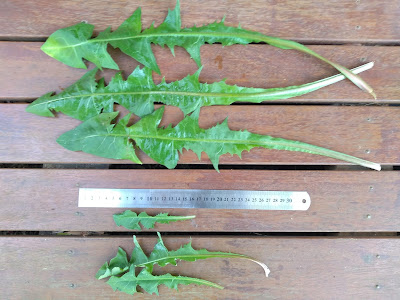
Giant edible dandelion comparison
Giant dandelion - 30cm ruler and leaves of regular plant for scale

Massive flat leaf parsley

My giant parsley is so impressively large that it is unique.  The leaves are absolutely massive and have the strong taste that is common among flat leaf parsleys.  The leaf stalks (petioles) are so huge that they can be used in the place of celery.  The roots do fork a bit, and sometimes have a woody core, but are large and taste incredible roasted (as most parsley roots do).  

This is not yet a stable variety as it still produces a range of plants from large to massive.  Some plants produce large round leaves, but this trait is uncommon (even when self-pollinated) and may disappear from this variety.  I mostly stopped growing this for some time because it got too large, but I still grow a little of it.    

Giant parsley leaf comparison
Massive parsley leaf - 30cm ruler and leaf of regular plant


Improved coriander

I love coriander.  Far too often coriander is bred only using selection, and very rarely through crossing different varieties.  This is not a stable variety, and I am doing my best to ensure that it never will be.  I deliberately mass crossed a dozen or so varieties of coriander, some that were bred for leaf production, others for seed production, others were said to be slow bolting.  I keep introducing parent varieties, earlier generations, and other improved varieties.  The result is a highly genetically diverse grex population of mostly large leaf, large seed, and slow bolting coriander.  Most have the usual white coriander flowers, but some have pink/red stems and flowers.  When you grow this you cull anything that flowers early and you quickly establish a variety that is slow bolting in your garden. 

Coriander leaf

I can't get enough coriander

Yellow Seed Grown Daffodils

These were the first of my seed grown daffodils to flower.  They reliably bloom for me every year, bulbs divide readily, normally producing about 9 flowers per stalk.  The stalks are often quite long, making them excellent cut flowers.  On top of all this, the flowers are highly fragrant.  
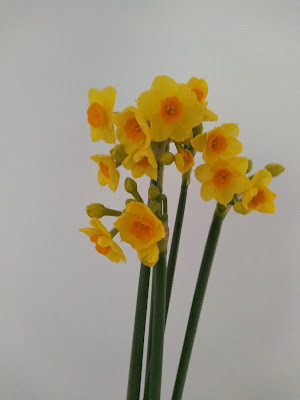
mudflower original daffodil
Yellow seed grown daffodil

White seed grown daffodils

This white seed grown daffodil is the sibling to the yellow.  It has star shaped, pure white flowers with pointed petals.  It is very fragrant.  These took longer to flower than the yellow when grown from seed, but are flowering well each year.

White daffodil seedling

Muscari - Grape Hyacinths

I started growing muscari from seed just to see if I could.  It turns out, muscari need special requirements to germinate, but once these requirements are met they are very simple to grow from seed.  My plants seem to have a lot of genetic diversity, as seed grown siblings look quite different.  These flower from seed after about 2 years, and the bulbs divide very quickly, so once you find a seed grown individual that you like it is simple to start a patch of them.

Seed grown muscari grape hyacinth siblings
Muscari grape hyacinth selections

I am adding to this post from time to time as I have a lot of breeding lines, some are almost stable, while others are still segregating.  

I bred these varieties myself, some were quick and simple, others took me many years.  I offer some of them for sale when I have enough to spare.  If interested, please visit my plant catalogue page.  Many are only available in some seasons, and in small numbers. 


Sunday, 12 August 2018

How to Prune Raspberries: Primocane vs Floricane Varieties Explained

Raspberry pruning seems confusing until you understand one simple idea: some raspberries fruit on first-year canes, while others fruit on second-year canes.  Once you know which type you have, pruning becomes straightforward.

In order to correctly prune raspberries or blackberries or any of their many hybrids it is important to understand their basic growth habit as well as what you want to get from them.  If you don’t understand their growth you will never get the full potential from them.  Your pruning method depends on the type of raspberry you're growing and whether you want one large crop or two smaller crops each year.
Floricane blackberry will not fruit well if pruned like this

Established brambleberries grow from a crown, each year they put up new growth, this new growth is referred to as a primocane.  The primo part of this word means 'first' as they are first year growth.

After the growing season is over the primocane will sit over winter and not do a great deal that you can see, the following season this older growth is referred to as a floricane.  Floricanes were originally the only canes that flowered, but we have since bred some varieties that can flower on their primocanes.   Knowing about floricane and primocane is important so you can prune them properly.

Raspberry plants

Primocane vs Floricane

All brambleberries (including raspberries, blackberries, and any of their many hybrids) can be roughly divided into two artificially imposed and sometimes slightly overlapping groups.  One group can only flower and fruit on old growth, we call them floricane (or summer fruiting)  The other group can flower and fruit on new growth, we call them primocane (or autumn fruiting or everbearing).  It is important to which about them as the way each group can be pruned can be slightly different.

All brambleberries have the ability to flower and fruit on a floricane, or second year growth.   This is how most of the wild brambleberries work.  Most varieties of cultivated brambleberries will only ever flower and fruit on floricanes.  This means if you prune your plant to the ground each winter, or if animals get in and damage the canes, the plants will be nice and healthy but you will never get any fruit.
My golden raspberries are floricane flowering

Summer-Bearing vs Autumn-Bearing Raspberry Pruning

Before pruning, it's important to know which type of raspberry you have.  Summer-bearing and autumn-bearing raspberries fruit on different canes, so they need to be pruned differently.  Once you know which type you have, pruning becomes much simpler.
TypeFruits OnWinter Pruning
FloricaneSecond-year canesRemove old fruiting canes after harvest.
PrimocaneFirst-year canesCut all canes to ground for one autumn crop, or leave selected canes for a smaller summer crop followed by an autumn crop (and potentially several more small crops).

How to Prune Summer-Fruiting (Floricane) Raspberries

Most people prune floricane varieties by leaving new growth and cutting out canes that have fruited the previous year. They also cut out the tip growth to encourage branching which means they produce more flowers.  It can be difficult to know which canes are which and there is extra time and care required to prune them.   Some people put tape or something around a cane that has fruited to show that it should be pruned out in winter, this takes time and effort.

Some canes die after fruiting, others will fruit again the following year.  Some people only prune in spring when the plants are breaking dormancy by removing any dead canes.  Again, it takes a little time and effort to achieve this.

One benefit of floricane varieties is that there are a lot of varieties to choose from, some do better in different climates and some fruit earlier or later than others.  Don’t ever buy an un-named variety, accept them if they are free, but don’t buy them.

Some brambleberries fruit on floricanes as mentioned above, but they also flower and fruit on first year growth, these varieties are referred to as primocane.  There are several ways to prune primocane varieties, there are benefits to each way.
Dormant raspberries, these are thornless primocane

How to prune Primocane raspberries to get one crop per year

The way that most people are encouraged to prune primocane varieties is each winter to cut it to the ground, this can be done quickly and easily if you run over the plant with the lawnmower.   The results are that the plant will throw up new growth in spring and fruit late summer/early autumn.

Many commercial producers prune in this way, it is fast, it is simple, and it is cost effective.  Different varieties fruit earlier or later so you can extend your harvest by planting a few named varieties.   Instead of the lawnmower you could carefully cut out each cane and use it as a cutting to grow more plants.   You have options depending on how much time and effort you have to spend on them.


How to prune Primocane raspberries for two or more crops per year

Another way to prune primocane varieties is to treat them as if they were floricanes.  Each year don’t cut them to the ground, instead leave that growth to flower and fruit next year.   Only remove dead canes, and possibly remove the tips of the floricanes.  Removing the tips encourages the plant to branch, thus producing more flowers and more fruit.  The plant still puts up new growth in spring, it still flowers and fruits on this new growth in autumn, but it will also produce an earlier crop on each of the floricanes.

Pruning like this gives you a second crop, an early crop from the floricanes and a late crop from the primocanes.  I have heard gardeners say that removing the floricanes helps the plant produce a larger crop on the primocanes, this seems logical enough, unfortunately every study I have seen on this tends to indicate this is not the case.

Brambleberries store a lot of energy in the roots, getting two crops each year does not appear to decrease the primocane crop in any way.

Thornless raspberries

Can you get a second crop from a floricane variety

I mentioned earlier that there is some overlap between floricane varieties and primocane varieties, this is where things get interesting.  I currently grow a thornless raspberry that is referred to as a floricane variety.  It usually only produces one large crop in summer on old growth.  Sometimes it will produce also produce a small autumn crop on each of the primocanes.  This second crop is not guaranteed, and is usually based on the weather, but it is still a primocane crop from a floricane variety.

Just like above, I prune them as if they are floricane, otherwise there is a chance that I will not get any crop from them that year.

There are a lot more floricane varieties than primocane varieties, this is simply because they are more prevalent in the wild and it took us a while to find good primocane varieties and breed from them.  I grow both primocane and floricane raspberry varieties, but I prune them both as if they were floricane and sometimes get two crops from both. 
 

Raspberry plants for sale in Australia

I grow several different varieties, some are thornless, some are primocane flowering, I grow black raspberries, I am one of the few people in Australia who sell a yellow fruiting golden raspberry.  I sometimes sell raspberry canes on my for sale page over winter when they are dormant.

Saturday, 20 February 2021

Thornless dual cropping raspberry

I don't think it is any great surprise to anyone who knows me that I dabble in plant breeding.  I particularly like growing edible things.  One I have been working on for a while now is a raspberry.  

I had a few good lines, some I culled because they weren't great, some died off last year with the drought and smoke, I still have the best one.

It is a completely thornless red raspberry that is dual cropping (primocane).  The berries are sweet, reasonable size, fragrant, don't seem to crumble, and are produced abundantly in rather large clusters.  

Being a primocane variety it flowers and fruits twice a year, if the weather is odd it can sometimes sneak in a (small) third crop, once they even produced a tiny fourth crop in winter and didn't go dormant.  Pruning is simple, you can just cut it to the ground at the end of autumn, or you can tip prune, or you can leave it, no matter what you will get a crop.

Like most/all other varieties of red raspberry, this sends out underground rhizomes and divides rather well.  

Lacking any thorns means that it is not a hassle to work with, and even children can easily harvest the delicious berries.  

The berries are produced in large numbers, each cluster can have dozens of berries.  I counted 48 individual flowers in one cluster!  When some berries are ripe there will still be unopened flowers in that cluster, meaning you get a long time of berry harvest.

All in all this is a great raspberry variety for back yards.  No thorns, great taste, multiple large crops, easy to harvest, simple/no pruning, quick to divide, there are no down sides to this variety.

I really need to name these, I am quite proud of them.  Most years I sell bare rooted crowns in winter through my for sale page.


Friday, 23 December 2022

Berry season - what's not to love!

I love berry season.  

Berry season came late to Australia this year, but is worth the wait!  

Below are some photos of our berries.  They taste so good.  We try to pick them when perfectly ripe, often rather soft.  They can't transport fresh berries when they are this ripe, so the only way to experience berries this good is to grow them yourself.

The darker berries below are thornless Youngberry.  They taste much like a boysenberry, can be eaten out of hand or they go tremendously well with ice cream.  Being so dark they are full of antioxidants, and they tend to add rich purple colour to ice cream.  

I love berry season

Youngberries and golden raspberries

Yellow raspberry - tastes floral and sweet 

Youngberry - tastes like boysenberry 

Sometimes the kids pick bowls full of mixed berries.  Whatever is ripe and easy to reach is picked first.  They are all delicious and their fragrance is incredible.  

Freshly picked berries, picked at their ripest, are far superior to anything you can buy from the markets.  Some of the varieties I grow are never found in the markets.  This means that the only way to enjoy them is to grow them myself.  


Berry season is here, and I love it!!!

Sometimes we only pick a few bowls of raspberries.  

I bred the red thornless primocane ones, they are nicely sweet.  This is what a red raspberry should taste like, rich, complex, and they smell like a delicious raspberry.  They are nothing like the raspberries you can buy from the market that are sour and bland at the same time.

The yellow raspberries have prickles on the canes and are a floricane variety.  The yellow raspberries taste very floral and have a unique fragrance.  A yellow raspberry tastes very different from a red raspberry.

My red raspberry is sweet and delicious 

The black raspberries are ripening and should be ready in the next few days.  

Not many people in Australia grow black raspberries.  They are a different species to the red (and yellow) raspberry, and the plant grows more like a blackberry than a red raspberry.  A black raspberry tastes very different to a red raspberry or a golden raspberry.  You likely will never see these in a market in Australia.

My black raspberries 

We have a few different garden strawberries as well as some different species of wild strawberries.  

My favourite garden strawberries are Cambridge Rival with its complex flavours, and the acid free Hokowase that is so sweet it can be eaten before turning red.

Garden strawberries
Wild strawberries are smaller than garden strawberries.  They tend to have stronger flavours and smell divine.  I grow a few varieties and several species.  

Wild strawberries tend to flower all year and fruit for most of the year, so berry season for them extends until the frosts.  This year the wild strawberries produced some really large berries, I don't know why.

Wild strawberries smell like a lolly shop


I do sell berry plants and dormant canes over winter.  I can post berry plants within Australia, but not to WA or Tasmania.  If you are interested they will be listed on my for sale page.